
Welcome to the OpenSea digest. Let’s look back through the biggest NFT and web3 news of the week.
CryptoPunk Zombie #3609 Sells for 420 ETH
AdamMetaverse, a pseudonymous crypto investor, surprised CryptoPunk collectors this week with the purchase of CryptoPunk #3609, an NFT from the Zombie Punk series. The Punk changed hands for a staggering 420 ETH, estimated at roughly $684,000 at the time of purchase.
The sale was initiated on September 17 when an address beginning with 0x93Ba acquired CryptoPunk #3609 from another address starting with 0x8f58. The purchase of CryptoPunk #3609 is considered a noteworthy event in the NFT space and signifies the historical importance of these digital collectibles.
The buyer, AdamMetaverse, expressed excitement about acquiring this blue-chip piece after initially debating between a Golden Ape or Zombie Punk. The specific NFT purchased is a Zombie-type Punk with distinctive attributes, including a do-rag and an earring, ranking it as the 211th most punk CryptoPunk according to Rarity Tools.
In comparison, a matching BoringPunk zombie #3609 last sold for 0.49 ETH on June 22, 2022. The item has received multiple offers since AdamMetaverse’s major buy but has tapped out at a ceiling of 0.073 ETH.
Ethereum Will Introduce EIP-4844
Developers in the Ethereum ecosystem are consistently designing new ways to scale the blockchain, making the experience of transacting NFTs and recording the resulting data both cheaper and faster.
Blobspace, a forthcoming Ethereum feature expected to roll out soon, is the latest scaling solution poised to do just that. Nicknamed “proto-danksharding” after its inventor Dankrad Feist, EIP-4844 is an Ethereum Improvement Proposal designed to drastically drop service fees (aka “gas”) and improve the throughput capabilities of the Ethereum mainnet.
Once implemented, proto-danksharding will work like this: Rather than trading traditional blocks of data, Ethereum will sell "blobs"— temporary and manageable portions of transaction data that are faster and easier to process.
A single blob can contain up to roughly 125 kilobytes of data, and it can be stored for up to 18 days before deletion. Blobs are not stored within transactions but rather in a "sidecar," validated and shared on Ethereum's consensus layer. The creation of a blob involves intricate mathematical processes, resulting in a unique identifier for the blob that the Ethereum Virtual Machine (EVM) can utilize. Once deleted, a blob’s identifier can still be located to ensure data integrity.
Why do blobs matter for NFTs? Industry professionals are optimistic that EIP-4844 will increase Ethereum’s throughput, potentially even raising it more towards the 1,000 transactions-per-second mark — a tipping point that would suggest better mainstream scalability and commercial viability for the blockchain industry.
While blobs will have their own fee associated with them (similar to gas fees), hopefuls believe EIP-4844 will significantly reduce the costs associated with buying and selling NFTs.
TON Foundation Working with Telegram
In an exciting collaboration, The Open Network (TON) Foundation has started working with the popular messaging platform Telegram, signaling a major boost for web3 adoption.
The partnership kicks off with the integration of TON Space, a new self-custodial crypto wallet within the Telegram app, accessible immediately to the messaging service’s 800 million active users. Telegram users can now access TON Space directly from the app's menu, putting digital ownership firmly in the hands of the users.
TON Foundation has set an ambitious target to onboard 30% of Telegram's active user base by 2028, which would translate to approximately 500 million individuals using the TON ecosystem. While those who already use the Wallet in Telegram feature can access the TON Space wallet, this new feature will roll out globally by default to all Telegram users outside the U.S. starting in November.
Checks PFP: Semi-Soulbound Token Airdrop Unveiled
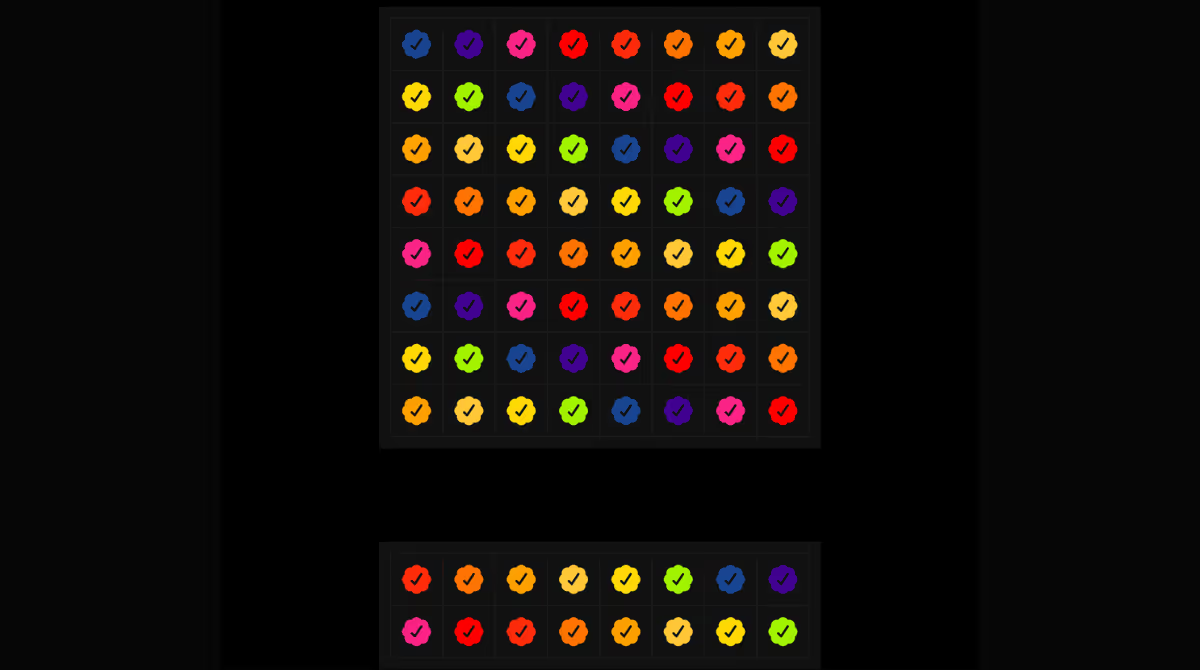
Checks, a viral NFT project that began as an $8 open edition drop in January 2023, has announced its newest iteration: Checks profile pictures (PFPs). The freely-claimable PFPs were airdropped on September 14 and are still claimable on the Checks website for Checks token holders.
Checks PFPs are semi-soulbound, meaning when the Check moves, the PFPs can be reclaimed by the new owner. To execute the drop, the Checks team introduced a custom ERC-721 extension aptly named "Mirrored721." The magic happens through a straightforward yet powerful "mirror" function that identifies the current owners of both the Check and PFP tokens. If the PFP token doesn’t yet exist, it is minted and transferred to the rightful owner. Interestingly, anyone can invoke the "mirror" function for any token ID, thereby facilitating the transfer of tokens to the designated owner(s). True to Checks style, this capacity for user-initiated transfers offers new potential for community-driven engagement and offers a glimpse into even more novel possibilities of digital artistry in the blockchain era.
Additionally, the generative process behind the Checks PFP artwork is also interesting to note. Artwork is generated when the Checks PFP smart contract fetches on-chain art from the Checks contract and assembles the scalable vector graphics (SVG) to create its distinctive variant. An off-chain file renderer complements this process, ensuring that the NFT artwork transfers to different file types for use on social media (in particular, X, formerly Twitter).
While Checks PFPs may not be tradable, they are undoubtedly a unique addition to the NFT world. Those curious about the collection may visit the dedicated Checks PFP page on OpenSea to browse and appreciate these distinctive pieces.
For those eager to acquire their Checks PFP, the process is straightforward. Visit the Checks website at burn.checks.art to claim your token.
Nakamigos Unveils Nakamigos-CLOAKS
Nakamigos-CLOAKS, the highly anticipated collection that will offer holders global gaming and commercial rights, is set to make a splash in the NFT world. With a release date just around the corner, here's all the information you need to know about this exciting project.
This series includes 20,000 unique characters of varying rarity and is categorized into three distinct types: Warriors, Knights, and Archers. Originally, the Nakamigos team had planned to offer CLOAKS at a price of 0.05 ETH each. However, inspired by community feedback, the project is providing a unique free-minting opportunity for Nakamigos holders starting at 12 p.m. ET on September 21 and concluding at 3 p.m. ET.
To be eligible for this exclusive free-minting opportunity, Nakamigos holders must have had their tokens in their possession by the snapshot time: September 19 at 11:59 p.m. ET.
Following the free minting period, beginning on September 22 at 4 p.m. ET, the Nakamigos-CLOAKS series will be available for public minting. Units can be acquired at a price of 0.05 ETH per unit, welcoming a wider audience to join in on this NFT experience.
Base Reaches Almost 2M Transactions in a Day
Coinbase's layer-2 network, Base, has achieved a major milestone by recording nearly 2 million daily transactions in just its second month of existence since its launch on August 9, 2023.
Data from the blockchain explorer BaseScan revealed that on September 14, Base Network processed a staggering 1.88 million transactions, surpassing its initial record of 1.41 million on August 21. In this achievement, Base Network outpaced other layer 2 competitors like Optimism and Arbitrum, which combined for 878,000 transactions that day.
Despite this substantial growth, Base Network still trails behind major blockchains like Polygon and Binance Smart Chain (BSC). As a comparison, Polygon on the same day recorded 2.1 million transactions, while BSC topped the list with 3.1 million transactions.
It's worth noting that, while Base Network's previous record in August also included 136,000 daily active users, this recent surge in transactions was not accompanied by the same level of user activity, as it registered approximately 86,000 daily active users on September 14th, according to data from Dune Analytics.
Since its launch on August 9th, Base Network has gained widespread adoption in the crypto community, allowing users to bridge tokens, swap assets, mint NFTs, and more. The platform has seen over 700,000 NFTs minted by more than 268,000 unique wallets on September 6 during its Onchain Summer event, and over $242 million in crypto assets bridged to the network in its first two weeks.
Circle's USDC Stablecoin Now Available on Polkadot
Circle, the issuer of the USDC stablecoin, has introduced the native version of USDC to the Polkadot, an interoperability network known for its ability to connect various appchains.
The dollar-backed stablecoin can now be transferred to app chains within the Polkadot ecosystem via a distribution system known as the Polkadot Asset Hub and the XCM protocol, a consensus framework that enables communication between chains. As a result, several Polkadot-based projects — including on-chain credit platform Centrifuge, liquidity protocol HydraDX, and cross-chain smart contract platform Moonbeam — have chosen USDC as their flagship stablecoin.
This expansion adds Polkadot to the growing list of blockchain networks supporting native USDC. The currency is currently the second-largest stablecoin in the market, with a market capitalization of roughly $26 billion at the time of writing, as reported by CoinMarketCap. Circle’s move reflects an ongoing trend of stablecoin providers expanding their reach across multiple blockchain ecosystems.


.png)
.png)
.png)