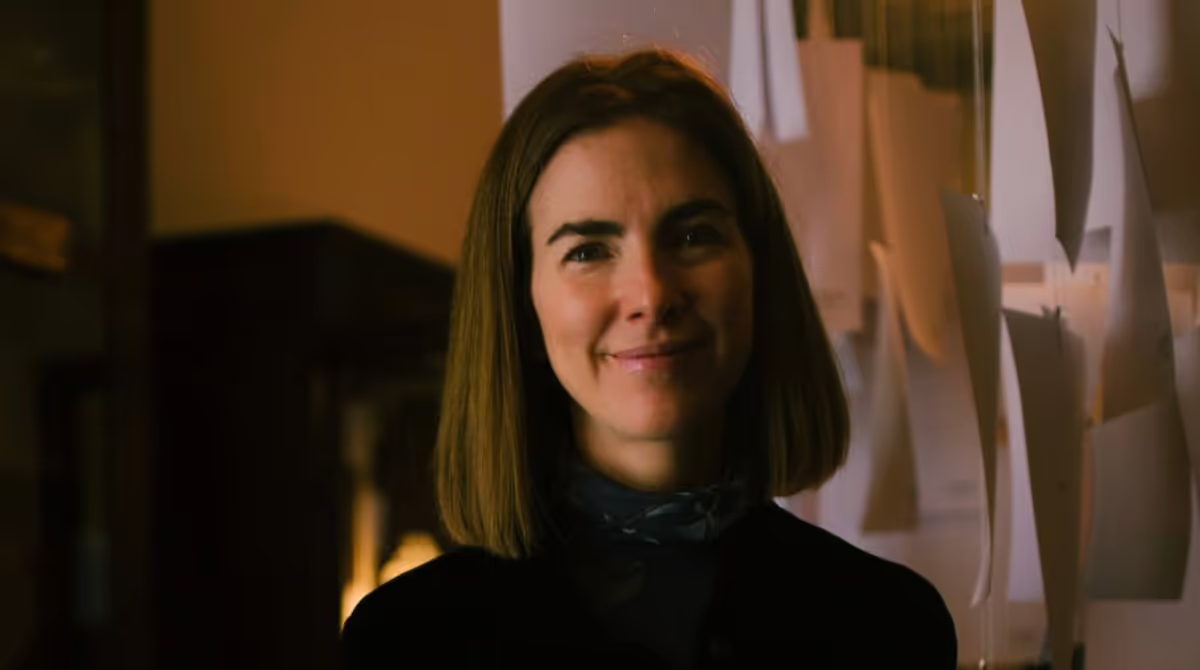

Ana María Caballero is a first-generation Colombian-American poet and artist who explores the intersection of biology and societal and cultural norms in her work. She challenges romanticized views of motherhood and questions the societal packaging of a woman's sacrifice as a virtue.
Caballero has received several prestigious awards in the traditional literary world, including the Beverly International Prize and Colombia's José Manuel Arango National Poetry Prize. Her digital work has also been published and exhibited internationally, marking her as a prominent figure in what she describes as the “web3 literary revolution.” Alongside poets Sasha Stiles and Kalen Iwamoto, Caballero co-founded theVERSEverse, a literary NFT gallery onboarding acclaimed writers to web3.
Recently, mint passes for the exclusive release of Caballero's "Paperwork" in the Bright Moments Buenos Aires collection sold out. The demand for Caballero’s mint passes marks a noteworthy achievement that highlights the enthusiasm surrounding her poetry and, more specifically, how poetry and blockchain can combine to create shared connection and new meaning.
OpenSea: It's always refreshing to engage with your work because of how much of your heart and personal life you share in it. How much of your success as a web3 artist do you attribute to the fact that you are, perhaps first and foremost, a poet and storyteller who can write about your life in a compelling and relatable way?
Ana María Caballero: I think that's huge, to be able to tell your story in a way that makes people want to read it. And to understand that you need to tell it for different formats. Like, there is the brief format, there's long-form, there's performance, there's the visual format, there's the spoken-word format. As writers, we're communicators, and as writers, we often have to hold many jobs in order to survive. So I've worked in many communications-related fields — like so many different ones — and you learn how to communicate, how to generate messages that people will remember. I think that that's definitely a useful tool to have in life.
OpenSea: On that note, “Paperwork” was inspired by the emotional responses that people had to your work. What is it like to receive such a response from an audience?
Ana María Caballero: You know, I never knew that this would happen. This has been a big surprise for me. My work is very much about giving voice to what's left unsaid in the home. And it's very feminist. I speak about the body. I speak about menstruation. I speak about sex. I speak about breastfeeding. I speak about my marriage, my mother, my children. It's all very, very personal. The way that people have connected with my work is really moving. Every time I read, someone comes up to me and says, “Thank you for saying that. I don't know how you had the courage to say that.” That just kept surprising me, how many people just felt seen by my private stories. And that gave me the courage to just keep going.
OpenSea: How long have you been writing about these themes?
Ana María Caballero: I've been writing these kinds of poems forever. I didn't start writing them in web3. It was just that I started having dialogue with people about them in web3. I always say that one of the reasons I entered the digital realm is because I felt that traditional publishing didn't offer writers a way to really connect with their readers. I would publish these poems and I never knew who read them. And I wanted that like I wanted to see if anyone was touched or not. Web3 has that engaged audience which is truly powerful. And these connections really inspired me to start thinking of a way to turn it into art, how to transform these moments of connection to verse into art via the digital, which felt like a very compelling use of web3 and of technology for me, and a very truthful outlet for my practice.
OpenSea: Can you share how the collaboration between you and Bright Moments came about?
Ana María Caballero: Well, I am a huge fan of Jorge Luis Borges and Julio Cortázar, Argentina’s two iconic writers, and I am actively reading both of them right now. So my mind was already in the pages of Borges and Cortázar when I began discussing Buenos Aires with Bright Moments founder Seth Goldstein, and everything fell into place. “Paperwork” was already underway before I began speaking with Seth. I had already performed at two of the four venues that ended up composing the whole collection. I had these papers to show Seth and some digital paper sculptures which I kept working on. When we had our first call, I had a folder with, like, 40 of them. So I didn't really know where this collection would live or how, but it seemed really just the right fit, because Bright Moments is all about creating experiences around the creation, or the co-creation of art, where the collector is the one who's birthing the art in the moment, live. “Paperwork” needs a live audience to connect with my performed poetry in order for the collector to receive the final artwork and sort of close the cycle.
OpenSea: Can you explain the process of how your poetry performances connect with the creation of digital paper sculptures?
Ana María Caballero: Absolutely. The performance involves me reciting poetry and then asking the audience to respond with a single word. I collect these words, distilling private moments of connection to my verse, and in the first three venues, I amassed around 100 of them. Then, when I performed in Buenos Aires, I read my poetry and afterward asked everyone to go and pick whichever word most closely resonated with how they felt. Arranged into a room were the words that other people had written throughout the year. This way, they were connecting with a total stranger’s emotional reaction to my verse. So we’re triangulating the collector, the stranger, and my performance in a moment of shared meaning and connection. It’s a memory and it’s an artwork. Then we also had paper slips that were signed and sealed by me for them to take home. The synergy was perfect, considering Bright Moments is all about creating immersive art experiences.
OpenSea: Tell us about the AI-generated origami mint passes. These are the digital sculptures you’ve described, yes?
Ana María Caballero: Yes, that’s what collectors got as their reveal. What Bright Moments does is that you travel and buy mint passes. So you get the right to have a work, and with these mint passes, you get the reveal in the moment. So, for example, I just sent a collector the photo of the actual handwritten paper for “entropy.” A collector picked “entropy” after she heard my reading, and so she got the digital paper sculpture representing that word. What sets my collection apart is the curation, which is a little different for Bright Moments. Each word was carefully matched with a specific sculpture to convey a particular emotion. After the performance, collectors received a reveal in the form of a digital paper sculpture corresponding to their chosen word.
OpenSea: What was the response from Bright Moments regarding this curated approach?
Ana María Caballero: They’ve been amazing. They really made space for me. I was initially concerned about deviating from their usual generative approach, but they fully supported and assisted me throughout the process. They helped me create these insanely gorgeous sculptures.
OpenSea: For those who missed the mint passes, how can they experience or engage with your collection?
Ana María Caballero: Bright Moments surprised everyone by unbundling their Buenos Aires collection mint packs. Collectors can now mint a work by each of the ten artists in the Buenos Aires collection, including mine. Now, a few additional individual mint passes are available for my Paperwork collection, each priced at 0.15 ETH. Collectors who secure these passes will receive a unique 1/1 digital paper sculpture and be able to mint their sculptures via the Bright Moments website, experiencing a virtual minting process similar to the one we had in Buenos Aires. I'm also excited to share that a performance of my Buenos Aires reading will be available for viewing. Bright Moments will upload all the uncollected individual words and digital paper sculptures, allowing collectors to see which word corresponds to which sculpture. Holders of the Paperwork mint passes can watch my performance and then choose the word they feel most connected to, unlocking the corresponding artwork. Collectors have the option to bypass the performance and directly acquire the sculptures if they prefer. Additionally, as an added bonus, holders of my mint passes will also have the chance to claim signed prints of the word they collect. This adds a tangible and personal touch to the digital collection.
OpenSea: Fantastic, thank you. Last, could you share which artists are currently inspiring you?
Ana María Caballero: Oh, my goodness. I am infinitely inspired by Operator and what they bring to the space. I recently met Rosa Menkman, who is amazing. She is a wonderful, wonderful artist. I love the generative artist Melissa Wiederrecht. And Nancy Baker Cahil is just a force and is doing such rigorous, thoughtful work. I also recently met Cross Lucid. If you don't know their work, you need to check it out. It's stunning. It's so powerful.
OpenSea: Thank you for sharing your insights and inspirations, Ana. It's been a pleasure connecting with you.
Ana María Caballero: It's such a joy to chat. Thank you for this interview.
Ana's full "Paperwork" collection on OpenSea can be seen here.


.avif)
.png)
.png)
.png)
.png)
.png)