.avif)

Daniel Koeth, better known by his artist moniker DK, reimagines everyday life through the lens of surreal composite photography. His signature blue skies, inspired by his childhood in Phoenix, appear as the constant backdrop of his work, contrasting against both the happy and bittersweet moments of life.
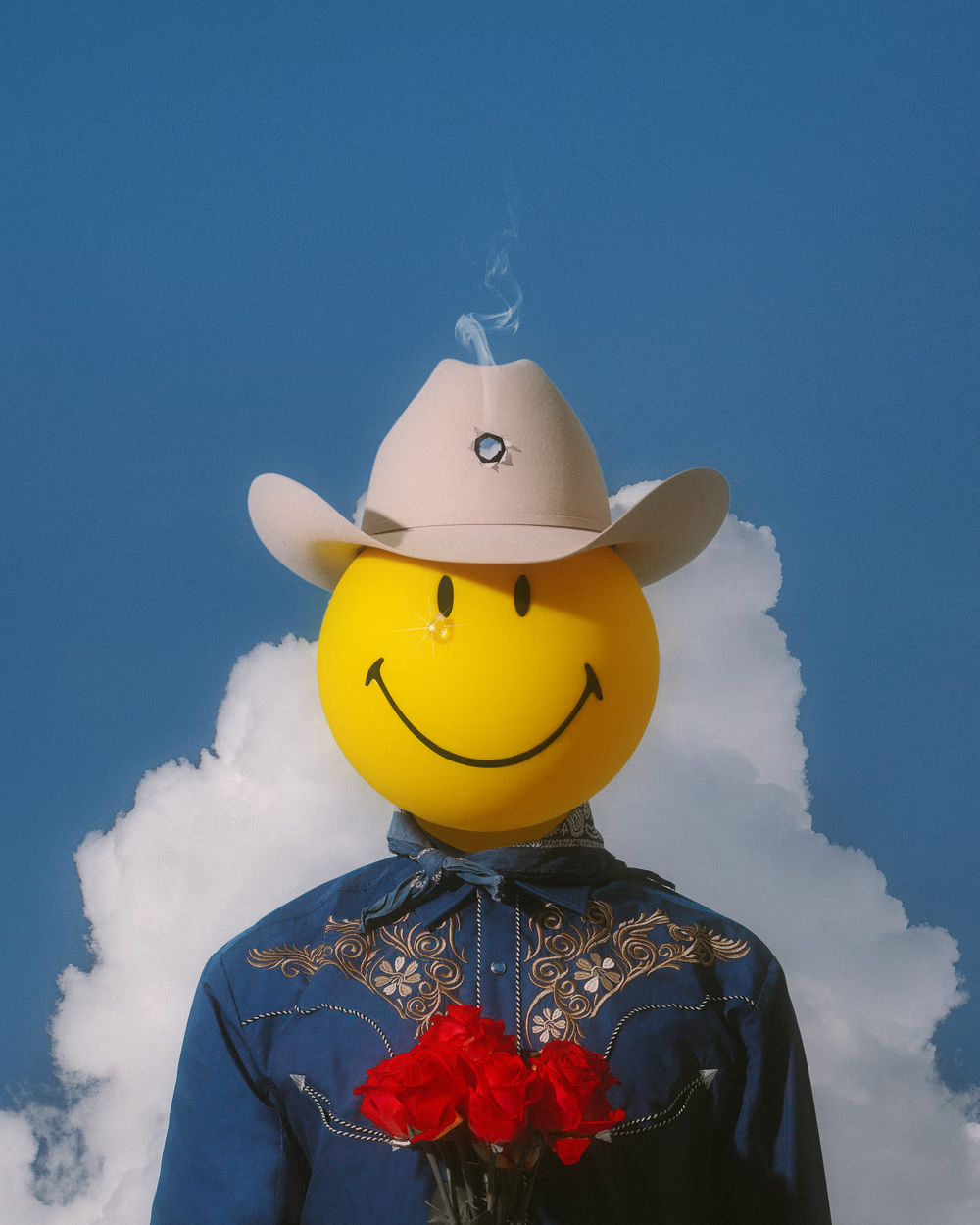
Having grown up under those huge Southwestern skies, DK channels the feeling of Americana in ways that feel both personal and culturally resonant. His collection of 24 one-of-one artworks features pieces like the Western-inspired “home on the range” and “Cowboys Don’t Cry,” where a cheeky 1990s smiley face dons a ten-gallon hat. If you look closely, you’ll find sharp commentary on technology and surveillance in collections like “Botanical Guardians,” in which poorly camouflaged security cameras peek out from blooming greenery.
Sitting in the Thunderbird Marfa during Marfa Art Blocks Weekend, DK spoke about his creative process, his ties to the Southwest, and how art became his way of processing the world around him. Through his work, DK turns the ordinary into the surreal, capturing not just what the eye can see in broad daylight, but also the emotions tied to seeing it.
Note: This transcript has been edited for length and clarity.
OpenSea: Let’s start with what initially brought you into the web3 space.
DK: I initially got into the web3 space from an investment perspective in 2021. It was a really new and exciting time with a lot of opportunities. Just by being in the space at that time, I happened to be there as photography started becoming a more viable art form within web3. Toward the end of 2021, I minted some of my work and found success, which was certainly unintended. As a lifelong photographer, I never imagined this would be possible. It absolutely swept me off my feet in more ways than one. It’s been a wild ride ever since 2021, to put it lightly.
OpenSea: Are there any specific tools or platforms you rely on for your composite photography?
DK: My work is heavily reliant on Adobe Photoshop. As a composite photographer, my process often involves layering anywhere between three to six different photographs. Photoshop is where I spend about 85 to 90 percent of my time during post-processing. Once the compositing is done, I move to Adobe Lightroom for the final touches. That’s where I focus on getting the colors just right and making minor tweaks to complete the piece. So my work is all in Adobe, essentially.
OpenSea: How do your personal experiences, culture, or background influence your photography?
DK: My background and life have absolutely influenced the work I do now. It’s been subconscious, and I’m only now retrospectively able to identify that’s where it came from. I’m from Phoenix, Arizona, where the blue skies are present more days than not. The blue sky has always been the backdrop of my entire life—good memories and bad memories have always existed in front of it.
This iconography has really resonated with me, and I’ve taken it and run with it. I’m not sick of it yet. That’s shaped by growing up there and always working with a blue sky, which has allowed me to explore it with more contrast. A lot of times, I play into the positivity of a blue sky because that’s the more common gut reaction — it feels positive and lighthearted — but since my whole life experience has been against that same backdrop, my work often plays on more melodramatic scenes happening against the blue sky. That’s 100 percent a result of having lived there and grown up in that space. Photography or video, lens-based art has always been around me. My mom’s a makeup artist, so I grew up on photo sets and around cameras. It was always in the background, but it wasn’t until I got older that I realized I enjoyed it. In a lot of ways, where I’m at now is the result of these environmental factors coming together in a beautiful and connected way.
OpenSea: When you’re creating a new piece, do you focus more on your inspiration for the work or how people might perceive it?
DK: When creating any of my work, I'm seldom thinking about the way it's received. Maybe that's considered selfish to a certain extent, but art for me has always been a very therapeutic thing, so it's very personal to me. I feel very fortunate to have the mindset of making work for myself, and as a result, people somehow enjoy it, have a positive reception to it, or are able to prescribe their own meaning to it in different ways I didn’t intend. That, in itself, is maybe a good argument for why it doesn’t make sense to think too much about how something will be received because you want people to feel something. But if, as an artist, you’re trying to leap ahead and make someone feel a certain way, you’re almost asking to be let down. So yeah, I make the work for myself, and the reception is this organic thing that often surprises me. It’s something I look forward to seeing, what that reception is. It’s a different component, a different aspect of the creation process, but it’s enjoyable in its own way.
OpenSea: Do you have any new projects you’re working on right now?
DK: Currently, I'm tying up the year with some collaborative work. From now until the end of the year, I'm wrapping up a few collections, again, mostly blue-sky centered. I have a collection called “Blue Skies Forever,” which is intended to bring together a lot of the characters, compositions, and iconography from all aspects of my work into one cohesive narrative. I'm working on putting a bow on that, but I also have some work planned that is the polar opposite — no blue skies. Instead, many of my characters will exist in darker, more melodramatic scenes that are outside my usual process and outside my current skill set. I'm diving into different compositions and experimenting with colors to push myself — not necessarily pushing limits but stepping out of my comfort zone. This darker work will probably come at the end of the year or the beginning of next year.
OpenSea: What does it mean to you to be here in Marfa?
DK: Being in Marfa has been an absolutely, incredibly fulfilling experience so far. And that’s great because that’s exactly what I was hoping for. Having been in the space for several years now and attending various events in different cities, I feel like I’ve got a pretty good idea of what to expect from most of them. But this is my first year coming to Marfa, and it has exceeded my expectations in so many ways.
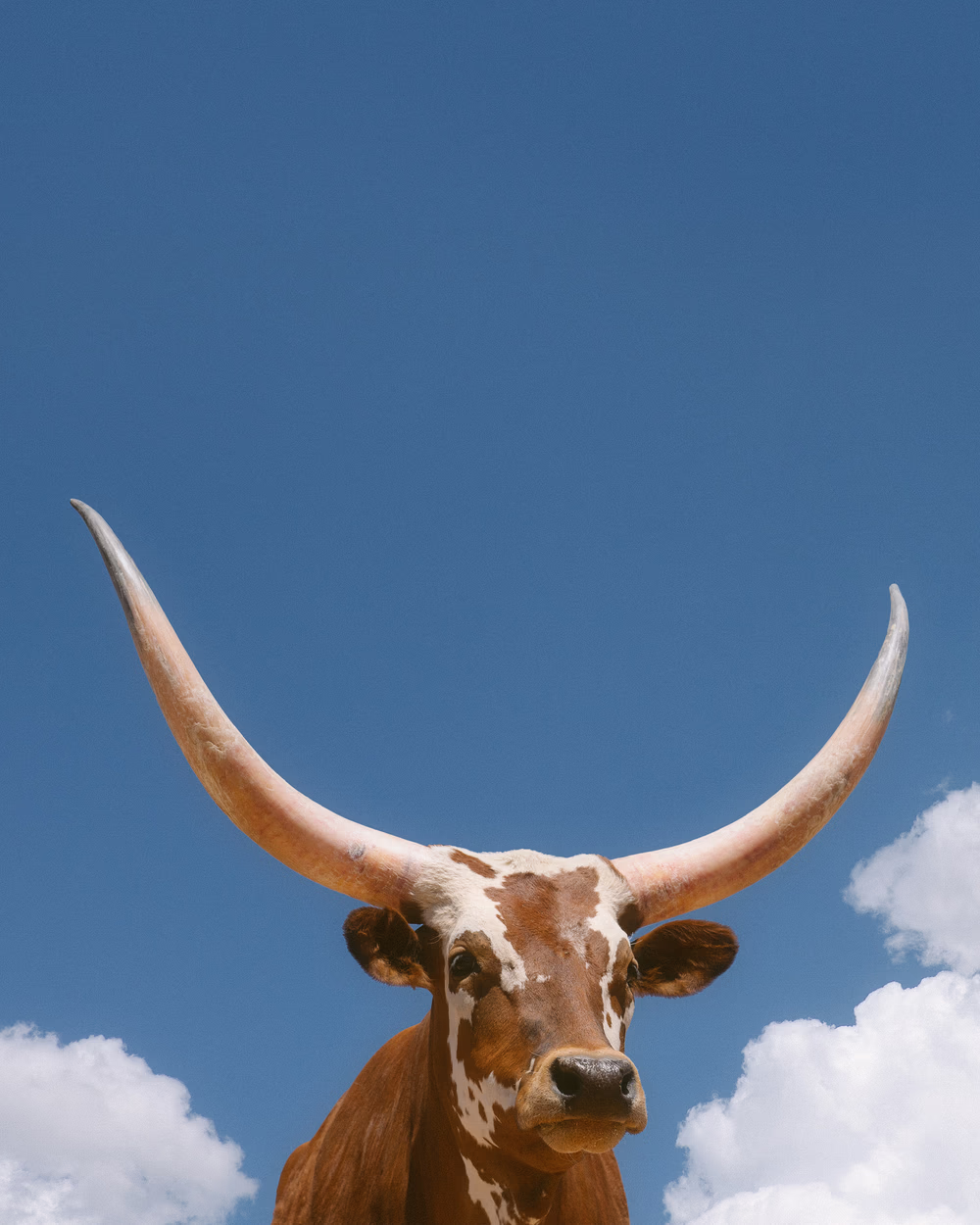
One of those is the scenery. I’m from Arizona, and we were shooting some blue-sky portraits this morning and afternoon. The backdrop here feels very much like home to me. That’s given me an extra little boost of comfort and confidence going into this weekend, which has been great.
The pace in Marfa is so much more approachable. You can have conversations here that might be more difficult to have in New York City or Miami, and that’s been such a beautiful experience. I just came from my first solo show, and here I’ve met people, photographed them, and had incredible conversations. Those kinds of moments feel harder to come by in other cities and events in this space.
And Marfa has this energy where every artist, company, and individual I’ve spoken to is really focused on pushing what’s possible, creating new trends — things that aren’t even fully defined yet. It’s been such a breath of fresh air. The inspiration here is endless. And honestly, having attended other events, this one feels incredibly unique. I think I can say it’s my favorite event of them all.
I hope to come back more and keep getting this experience. I’ve got an abundance of inspiration to take back home and work on. Saying this trip has been fulfilling might even be an understatement when it comes to my Marfa experience.

OpenSea: Finally, where can people find you and your work?
DK: The best way to follow my journey is on X at @DanielKoeth. I’m always on there, and I love meeting new people. My DMs are open, and I’m happy to have a conversation about anything.
OpenSea: Thank you so much.
DK: Thank you!
OpenSea: This was amazing. Thanks for taking the time today.
DK: It was an absolute pleasure!


.png)
.png)
.png)