.avif)

A digital sculpture that never stops moving. A virtual painting that rewrites itself. There are many ways to attempt to describe “Cycles,” the latest NFT collection from digital art studio Material Protocol Arts, but most of them would miss the mark.
And that’s kind of the point. Most art stays the same once it’s finished. But "Cycles" does the opposite.
It exists on the Ethereum blockchain, where it moves, shifts, and changes on its own thanks to code.
That means it doesn’t run on a gallery server or rely on an artist’s updates. Its on-chain address is within an unstoppable system consisting of 512 individual pieces called “lenses,” each running its own simulation.
Collectors, once they own the artwork, can freeze a lens, locking it in place, but unlocking it later depends on rules that haven’t all been revealed.
This system makes "Cycles" what its creators call a “hypersculpture,” something that can be programmed and networked across multiple related works. Instead of treating art as a single image, the project treats it as an ongoing process, where the artwork itself is actually the system that creates, records, and preserves movement over time.
To understand the intentions behind “Cycles,” we spoke with Matto and Neokry, two team members behind the studio Material Protocol Arts. They explain how “Cycles” was made, why Ethereum matters, and what it means to build a sculpture that never stops moving.

OpenSea: Can you briefly share your background and what led you to co-found Material Protocol Arts?
Matto: I have been some form of an artist for about 20 years. I had a long career as an electronic musician, running underground electronic music labels, releasing records, and touring mostly in Europe I also spent a number of years in video game development, where I learned programming skills.
Three or four years ago, as the NFT movement was getting started, I got involved in crypto art. It’s been a winding, multidisciplinary path. My brother, Seaweed, and I had worked together on various projects in the NFT space, including a video game/art project called Night Run. When we started working on "Cycles," we knew it would require an intense smart contract component.
I met Neokry through the intro to computing arts class taught by 113 in the Mathcastles Discord. We met in person in Tokyo two years ago, and I knew he was a really good, smart contract engineer. I reached out to him and said, “Hey, we’ve got this project.” We had talked about collaborating in the past, and he was looking for a long-term, studio-based approach. That led to the three of us founding Material Protocol Arts.
OpenSea: How did you and Seaweed begin working together?
Matto: Seaweed is actually my real-life brother, so I’ve known him my whole life. I’m older, so a good chunk of my life. He and I worked on previous NFT projects together. We entered the NFT space at the same time and learned alongside each other for the past four years.
OpenSea: What was it about the intersection of technology, art, and crypto that captivated you?
Matto: I’ve always seen technology as a powerful amplifier for creative ideas. Someone once called the computer a “bicycle for the mind.” It lets you do things you couldn’t otherwise.
When I first started making music, I was in film school. But I realized how difficult and expensive filmmaking was as an artistic medium. The guy I worked for had family money and could afford to fund his projects, and I saw that wasn’t going to be possible for me.
Music, on the other hand, was something I could create on my computer with minimal equipment. This was right when that was becoming possible, and I could distribute my music, even to a small but dedicated audience.
Crypto takes this independent, DIY model to a whole new level. Artists can be truly independent—create the work they want, sell it, and engage with collectors directly. It’s the opposite of the YouTube influencer model, where you need millions of views for little financial return. With NFTs, you can have 250 dedicated collectors and fund a project for a year. It’s an inversion of the platform capitalist model, one that empowers creators.
Of course, crypto comes with its trade-offs: volatility, scams, and uncertainty. But I think it’s one of the best opportunities for artists today.
OpenSea: How does this philosophy shape your approach to collector relationships?
Matto: Cultivating a collector base is foundational to independence. If you sell through a gallery, a lot of your collectors belong to the gallery’s audience. If you get dropped from that gallery, you lose access to those people.
With NFTs, direct relationships with collectors are possible. At Material Protocol Arts, Seaweed handles a lot of our collector relations. Managing those relationships takes time, but it’s crucial. That’s why we’re structured as a studio instead of as individual artists — so we can balance the creative and community aspects.
OpenSea: Let’s talk about "Cycles.” What inspired the project?
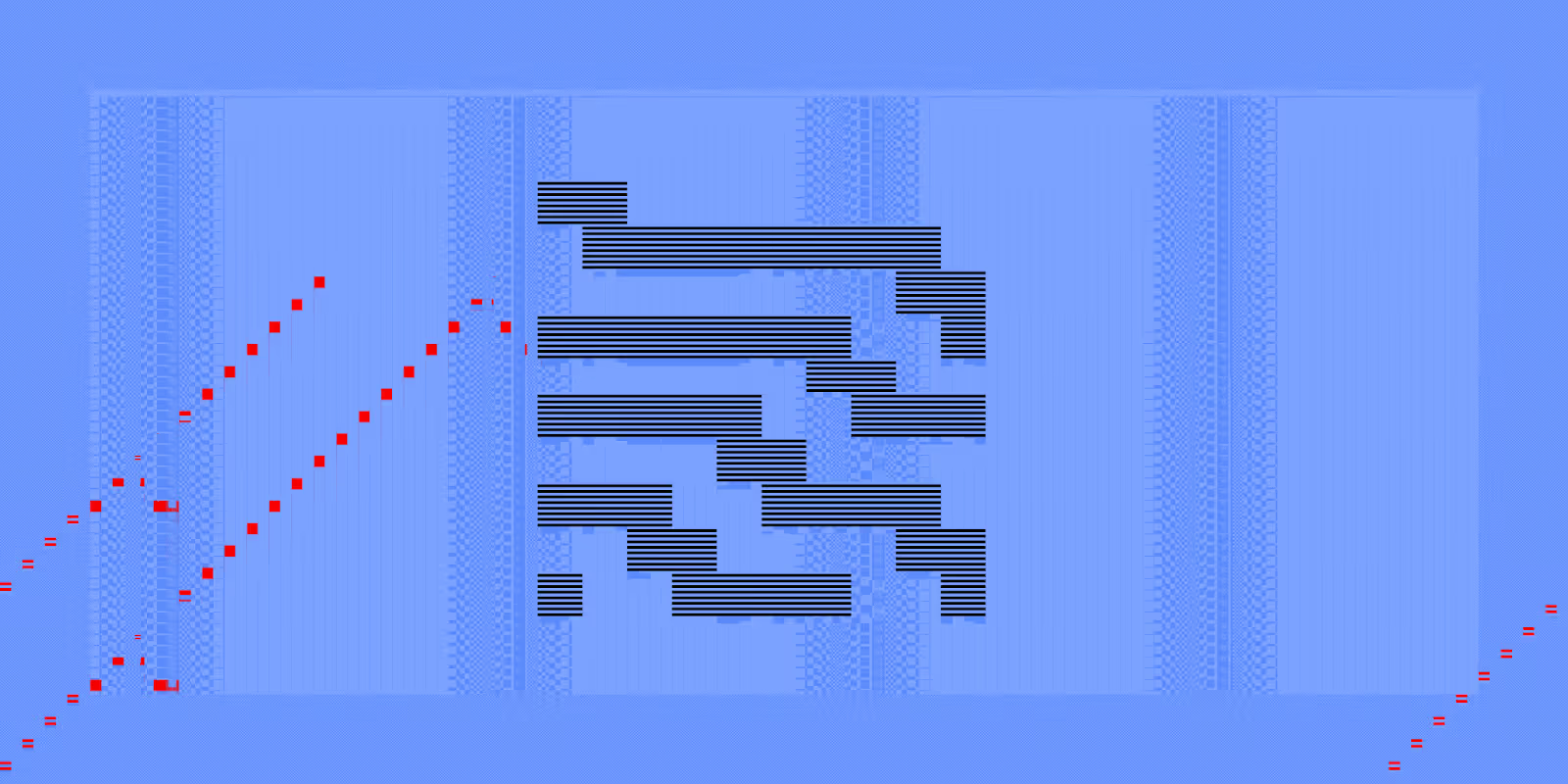
Matto: "Cycles" is a moving, abstract kinetic sculpture dynamically computed on the Ethereum blockchain. The artwork consists of 512 individual “lenses” that represent NFT tokens. These elements are computed on Ethereum and rendered using JavaScript and P5JS.
One key inspiration was “Terraforms” by Mathcastles. That project opened up a dialogue about dynamically computed, on-chain artworks. We wanted to participate in that conversation and extend that line of thinking. Since Neokry and I met through the Mathcastles Discord, there’s a natural continuity between these projects.
A central theme of "Cycles" is time and change. The blockchain acts as a one-way, write-only ledger, essentially creating history. We see Ethereum as a place for art-making, and we’re making the bet that it will exist for hundreds of years, just like how New York has been a cultural hub for over 400 years. In the future, Ethereum might even be preserved solely as an art platform.
OpenSea: Neokry, how does your technical background contribute to "Cycles"?
Neokry: I focus on the deep technical aspects, particularly Ethereum Virtual Machine (EVM) smart contracts. I wrote the smart contracts for Cycles, including the 3D calculations. We had to write our own 3D simulation code in Solidity for accurate rotational and matrix calculations.
One goal was to make "Cycles" highly interactive. Instead of computing movements in JavaScript, we put everything on the EVM so people can build their own interfaces on top of our sculpture. This allows collectors and developers to create their own generative art experiences using our data.
OpenSea: What was the biggest creative or technical challenge in developing "Cycles"?
Neokry: Doing 3D calculations in Solidity was extremely challenging because very few projects have tackled on-chain 3D work before. We had to take JavaScript libraries and rewrite them in Solidity to ensure the contract could accurately compute movement.
The effort paid off, though, because now others can use our data to create their own interpretations of the sculpture.
Matto: Another challenge was ensuring the project had artistic meaning beyond just being a technical feat. When creating art, there’s an unconscious impulse behind it. Since we’re working as a group, we had to articulate what we were trying to express.
We spent a lot of time refining our vision. We rewrote the "Cycles" art paper something like five to seven times before we felt we had captured its essence.
OpenSea: Both of you have mentioned a paradox in the way "Cycles" engages with permanence. Can you expand on that?
Matto: There was a period in the 20th century of dematerialization in art. Sculpture shifted from bronze and stone to being much more ephemeral and conceptual. Artists moved away from concrete objects. With this kind of distributed-world computer sculpture, we’re making a claim to longevity or durability. It’s a return to those desires for permanence but in a dematerialized, crypto-economic world. There’s a tension there, a paradox, and that’s something we’re grappling with.
OpenSea: That’s so interesting because historically, permanence has been tied to physical materials. For so long, people assumed materiality meant more permanence. If it’s made of stone, it’s written in stone — it’s permanent. But when I look at a stone statue at The Met Museum, for instance, I can’t immediately tell you anything about its provenance or its identity. Nor is it accessible from anywhere, universally and digitally. The ephemeral world of digital data suddenly seems to be a more permanent record in comparison, which is really fascinating.
Matto: Yeah, it’s interesting. I believe the nature of blockchain, both as a robust recording device and a computer, makes it significant for art history. That feels like a given to me, and people are just starting to catch up to that idea.
OpenSea: You also mentioned Ethereum as a site for long-term art-making. How does that fit into this idea of permanence?
Matto: A blockchain, one way to look at it, is a one-way, write-only ledger. It’s a recording device. It creates history. So using that as a site of art-making, with the hopeful idea that Ethereum will be here for hundreds of years, brings another level of permanence. The same way New York has been here for 400 years, we think Ethereum might be here for 400 years or more. One of the ways a city becomes important is through art. Putting art on Ethereum could mean that, in the future, even if Ethereum stops being useful as a finance platform, it may persist as an art platform, preserved by museums because of the art that people like Mathcastles and hopefully ourselves have put on it.
OpenSea: For people who are interested in collecting after reading this, what’s the best way?
Neokry: The mint is finished but you can buy on secondary now. The best way to reach us is by DM, either on the Material Protocol Arts page, Matto’s Twitter account, or mine. The contact form on our website works too, but DM is usually easiest for people.
OpenSea: Can you walk me through the timeline and mechanics of the original mint?
Neokry: We started selling hand-to-hand using an invite system. We built a process where we reached out to collectors, or they reached out to us, and we had direct conversations. After talking, if we felt it was a good fit, we created a personalized mint page for them. Once they clicked the link, they could mint one to three pieces from the collection.
When they minted, they received a soulbound NFT that represented their invitation to mint "Cycles.” Once all invitations were claimed around mid-December. We gave people a few more weeks to wrap up the loose ends. We deployed everything, and in early January, we opened up claims.
Collectors could then receive their full NFT, but we didn’t force them to claim immediately. Some naturally came to claim their pieces, while about 20 are still unclaimed. Some collectors haven’t realized claims are open, while others don’t want to reveal their pieces yet.
We like playing with social dynamics. Cultivating a collector base is important to us, and hand-to-hand sales helped us have direct conversations with collectors to make sure they understood the artwork on a deeper level.
OpenSea: What’s next for Material Protocol Arts?
Neokry: We’re working on a new project that pushes interactivity even further. Our goal is to build on the ideas in "Cycles.” including on-chain sculptures and interactive mechanics, but take them to the next level. We’re not revealing much yet, but it’s going to be exciting.
OpenSea: We can’t wait. Thank you so much for your time today.
Neokry: Thank you, you too.


.png)
.png)
.png)