.avif)
Acclaimed British artist Damien Hirst is the ultimate provocateur. For decades, he has turned heads while exploring bold themes like death, religion, science, art, beauty, and life in all his work, and now through digital innovation in the NFT space.
As both an artist and an art collector, Hirst has significant connections with notable collectors, such as businessman Charles Saatchi. He is most well-known in the traditional art world for his dead animal sculptures, which he infamously preserved in formaldehyde. They earned him a spot as one of the Young British Artists (YBAs), a cohort of artists in the UK who rose to prominence together in the late 1980s.
Since then, Hirst's artistic success and accolades have been steady as he expanded his art to include more sculptures, paintings, and, as of 2021, digital art.
Hirst introduced his paintings to the NFT world in 2021 through his genesis collection, “The Currency.” In the collection, a digital rendering of Hirst’s well-known Spots Paintings series, he asked holders to decide whether they valued a physical or digital art piece more. In the same year, he also designed the album artwork for rapper Drake’s “Certified Lover Boy” album, which inspired a different NFT collection, “Great Expectations.” In the 10,000-item collection, Hirst uses “The Currency’s” signature dots to depict pregnant women and explore facets of their beauty and individuality.
Since the beginning of his career, Hirst’s ability to tie together thematic threads across all of his works allows each piece and collection to feel like it flows seamlessly into the next. Even if individually, they feel disparate.
Read on to learn more about Damien Hirst’s digital art collections and how they often tie back to his previous, more traditional works and themes.
Early life and training
Born Damien Steven Brennan on June 7, 1965, in Bristol, England, Hirst's early life and training are somewhat shrouded in mystery, but what is known paints a picture of a young man deeply influenced by the punk movement and the visceral art of the Irisn-born painter Francis Bacon. Hirst attended the Goldsmiths School of Art at the University of London, where he studied fine art, although he did not complete his degree. His talent was evident early on, recognized and nurtured by his art teachers, who encouraged him to pursue a career in art. This encouragement set the stage for Hirst’s future endeavors in the art world.
Rise to fame
Hirst’s meteoric rise to fame began in the late 1980s as a pivotal member of the YBAs, a group that included notable figures like installation artist Tracy Emin and photographer Sarah Lucas. This collective dominated the UK art scene in the 1990s. They pushed boundaries and challenged traditional art norms. Hirst’s first major break came in 1988 with “Freeze,” an exhibition he curated himself in London's Docklands warehouse district. The show was a success and captured the attention of collectors and critics. In 1991, Hirst's inclusion in the Saatchi Gallery’s YBAs exhibition further cemented his status as a leading figure in contemporary art and marked the beginning of his enduring influence on the art scene.
Artistic style and themes
Hirst’s artistic style is unmistakably characterized by his obsession with life and death. His works often feature bright colors and bold patterns, which draw viewers in with their visual appeal while confronting them with deeper themes of mortality and the human condition. The controversial use of formaldehyde to coat dead animals in his early career created a stark juxtaposition of eternity (or at least preservation) with an otherwise lifeless subject.
Notable works
Hirst made a name for himself with the shark that dropped jaws. Created in 1991, "The Physical Impossibility of Death in the Mind of Someone Living," is a 14-foot tiger shark preserved and suspended in a formaldehyde rectangle. British businessman Charles Saatchi funded the piece, which reportedly cost Hirst in the ballpark of £50,000 to create and sold for a range of $8 to $12 million. The original shark eventually dissolved and had to be replaced in 2006.
Hirst then followed that up with "For the Love of God" a platinum skull covered in diamonds. His installations, like "A Thousand Years," which features a fly zapper and a cow's head, continued to push the limits of what art could say. Then came "The Golden Calf," where Hirst encased a calf in gold, yet again mixing shock value with deep artistic statements.
Hirst’s first NFT collection was an experiment for holders, and Hirst too
Hirst created “The Currency” as a 10,000-item NFT collection, whose supply has slowly dwindled since its 2021 mint. The reason why the current supply of NFTs is only over 2,000 (at the time of writing) is that upon owning an NFT, holders had one year to decide whether they wanted to keep a digital version of the work or a physical copy. As Hirst explained, with his social experiment, he hoped to uplift a conversation about which art is valued more.
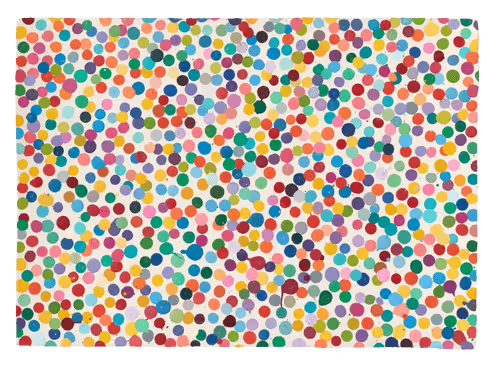
Upon the deadline, about half of the holders decided to burn the NFT in exchange for physical artwork, and another half chose to keep their NFTs, leaving Hirst to burn all the accompanying artwork physically.
Along with his art collectors, Hirst also had skin in the game since he owned 1,000 of the collection’s NFTs. He explains that his decision on which to keep came down to whether he was ready to commit to the NFT art world.
In a Twitter thread, Hirst added:
“I have been in the physical art world a long time and I expect people to have agendas and shit, and I’ve seen a lot of bollox and I’m amazed at how this community breeds support and seems to care about shit so in the end I decided I have to keep all my 1000 currency as NFTs...otherwise it wouldn’t carry on being a proper adventure for me and so I decided I need to show my 100 percent support and confidence in the NFT world (even though it means I will have to destroy the corresponding 1000 physical artworks)...”
His confidence in the contemporary art NFT world inspired him to introduce more collections
The month after Hirst minted “The Currency,” the collection generated $25 million in sales. Hirst took the success from that first collection and quickly brought to life other NFT collections, including “Great Expectations,” a free airdrop for “The Currency” holders.
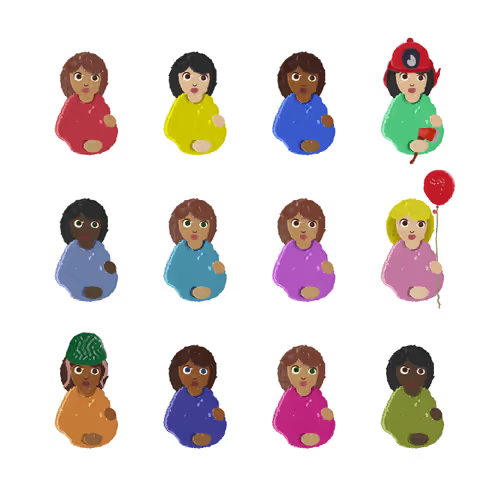
The Drake album-inspired collection used the colorful spots from “The Currency” to create grids of emoji-like pregnant women, according to art technology company HENI, which partnered with Hirst for both collections. Hirst designed the digital art pieces based on the same visual style he used to create Drake’s album cover.
In 2022, Hirst introduced a butterfly-inspired NFT collection, “The Empress,” which emphasized the beauty and power of the butterfly and the leading women he named each artwork after. Each butterfly in the collection is an empress butterfly with red, orange, and black patterns overtaking the glittery, kaleidoscope-like prints. Hirst named each print in the collection after five empresses who inspired him, including Chinese empress Wu Zetian, Byzantine Empire empress Theodora, Mughal Empire empress Nūr Jahān, Japanese empress regnant Suiko and Ethiopian empress consort Taytu Betul.
As described in HENI, only one of the five prints has a slightly asymmetrical pattern, which Hirst created intentionally as an ode to the Byzantine Empire’s Theodora’s groundbreaking feminist policies.
As of 2024, Damien Hirst has focused on his most recent art exhibit, “Dominion.” Hirst’s son, Connor Hirst, curated the exhibit, a mix of Hirst’s work and pieces from other artists. It ran at Hirst’s founded art gallery, Newport Street Gallery in London.



.avif)
.png)
.png)
.png)

.png)