A new tool is changing how music artists and creators remix their favorite songs to match our increasingly virtual lifestyles.
KOR Protocol, a decentralized intellectual property (IP) platform designed to help creators protect and monetize their work, launched for creators and developers worldwide on September 26. Backed by major web3 players like venture studio Animoca Brands, private investment platform Republic, and the Solana blockchain, the KOR Protocol uses blockchain technology to provide a scalable and transparent IP management system.
Starting this week, developers everywhere will be able to access KOR Player’s software development kit (SDK) to install and use the protocol. Gone are the days of recording mixtapes from the radio onto cassettes. With KOR Player, friends and creators can collaboratively transform music into game soundtracks, fan-made remixes, and more. KOR Protocol is a sophisticated tool to mix licensed music and other content into these virtual environments, all without — and here’s the kicker — violating copyright rules.
Pixelynx, the company behind the protocol and its KOR Player, reports that over 600,000 users have engaged with related projects, including Pixelyn’x AI music platform KORUS and Netflix’s Black Mirror “Smile Club” experience, which sold out in under three hours back in February 2024. This activity has resulted in approximately 285,000 NFTs minted and $1.5 million in revenue generated.
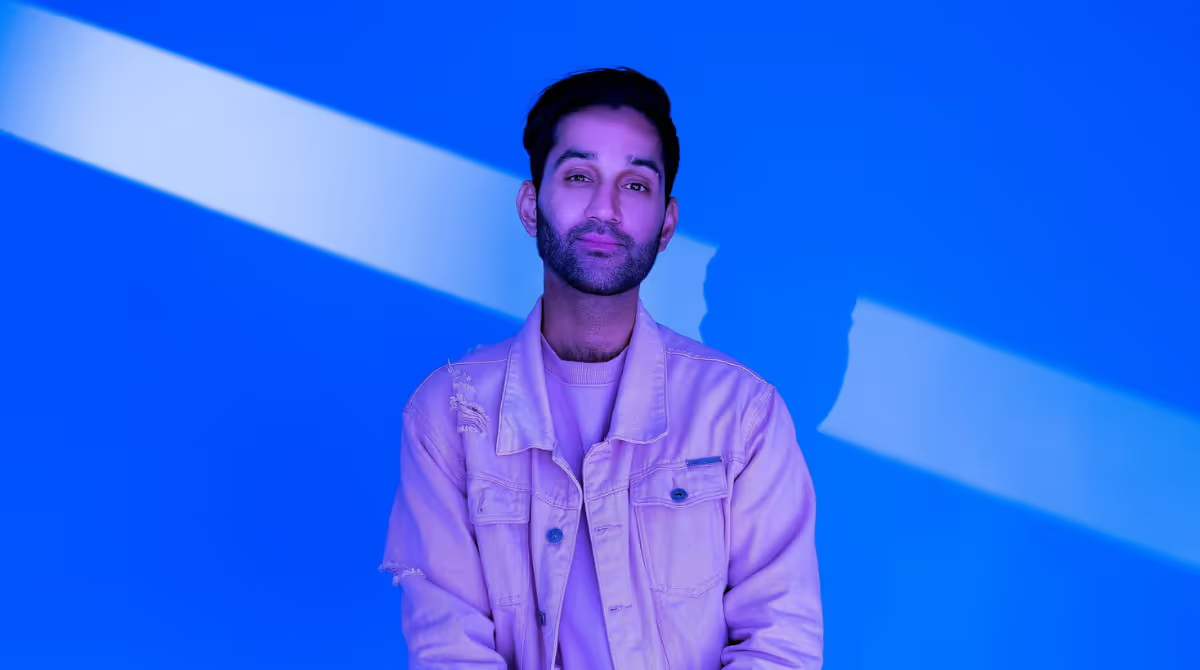
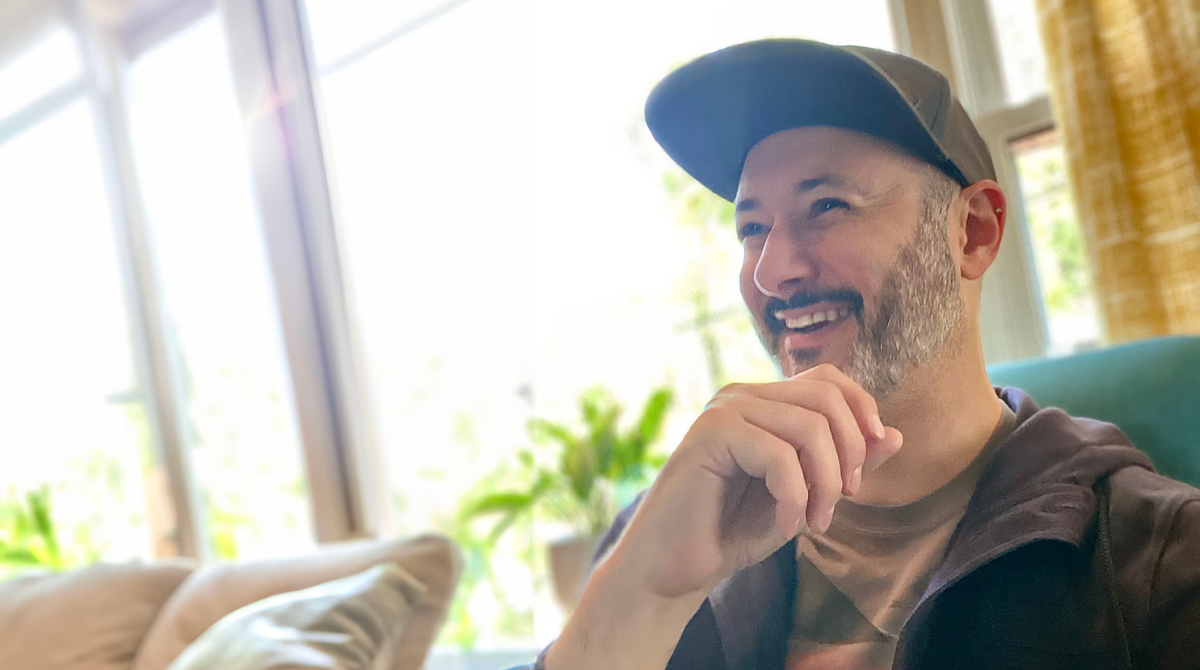
Entertainment industry veteran and CEO Inder Phull leads Pixelynx and its various campaigns, along with electronic musicians Joel “Deadmau5” Zimmerman and Richie “Plastikman” Hawtin. To get a closer look at how KOR Protocol is driving this evolution, we sat down with Phull to discuss how it works, its potential impact on digital rights, and the future of entertainment as he sees it.
Note: This transcript has been edited for length and clarity.

OpenSea: You’re calling in from Dubai today. Last we spoke, you were living in Los Angeles. What prompted the move to the UAE?
Inder Phull: We just moved here a few weeks ago. We’re moving into the next phases of the company's growth. It was between here and a few other places, and we decided to come here. It’s a little closer to home as well; I’m from London.
OpenSea: A lot has happened in the two years since we spoke. Are you ready for this release on September 26?
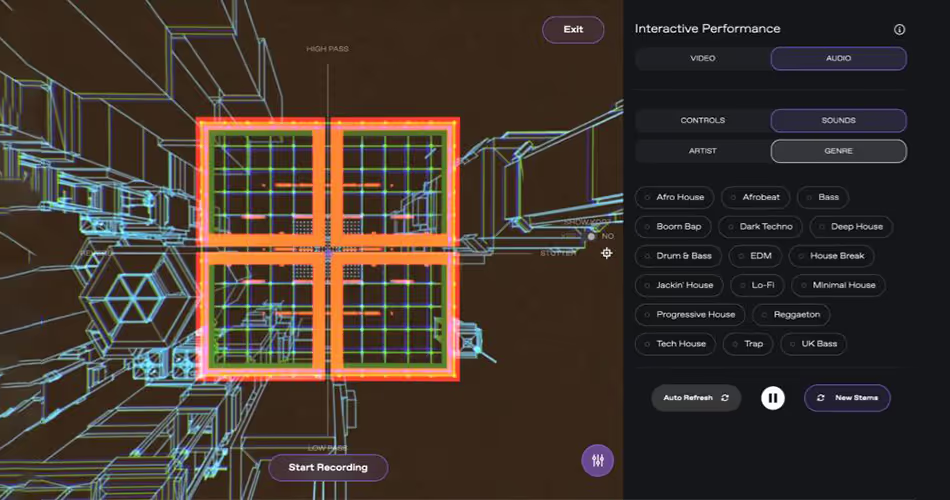
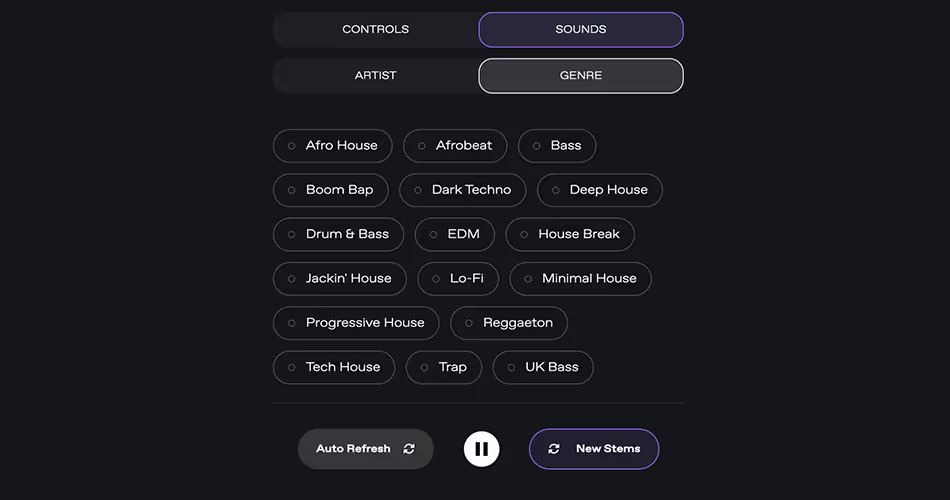
Inder Phull: Yeah, KOR Protocol is really the consolidation of the whole ecosystem in many ways. We’ve been working on a lot of different IP-based applications and experiences. We’ve got one product called KORUS, which is our remixing platform, and it’s doing really well. We also launched a Black Mirror experience earlier this year. The goal of the protocol is to take all the technology we’ve been building and unlock the next phase of growth through on-chain IP management and distribution.
OpenSea: That must be exciting to see your vision come to life.
Inder Phull: It’s exciting. The market has been constantly shifting — it’s crazy. But it’s exciting. A lot of the things that were in the earliest business plans four years ago are starting to line up now.
OpenSea: For those unfamiliar with Pixelynx, how do you explain what you do in a sentence or two?
Inder Phull: We’re building an entertainment ecosystem that lets IP holders bring their IP on chain and grow with their communities through different applications. We’re very focused on creator experiences, which we believe allows fans and creators to build alongside their favorite IPs.
OpenSea: You are bullish on the metaverse, where a lot of the applications of the experiences you describe would naturally take place — inside virtual environments like games, sandbox worlds, etc. There are lots of different definitions of the metaverse. Some call it the spatial web, while others say it’s less about real-time spatial computing and more about simultaneous virtual experiences, with even things as simple as Zoom or asynchronous work falling under the “metaverse” umbrella. How do you define it?
Inder Phull: Those are all elements of it, for sure. The metaverse is interesting because its definition has been fluid and changing. I’ve always thought about it as the future of the internet and entertainment to some extent. It’s a consolidation of technologies — blockchain, identity tooling, and applications like games — that make the internet more immersive. And with web3’s new forms of ownership, the metaverse becomes a whole new business model. If I had to sum it up, I’d say it’s about immersion and ownership.
OpenSea: So you’re in the camp that believes the metaverse needs to include digital ownership, not just immersive gamification and 3D graphics. When did you first align yourself with the idea that ownership is core to an open metaverse?
Inder Phull: So my journey in blockchain started about 10 years ago when I read a research paper about how rights — particularly copyright and music rights — could be transformed if managed on the blockchain. That led me down the rabbit hole of understanding the technology. About five years ago, when Fortnite launched the Travis Scott experience, I started connecting the dots. People were buying digital items and content but didn’t own them. If they could, new forms of value creation would be possible. We did our first NFTs about four years ago, and they were in-game items with constructs of ownership and transparency around licensing.
OpenSea: Tell us about your NFT projects.
Inder Phull: We’ve done several NFT drops. One was with Deadmau5, around his IP and some of his songs and digital artworks. We also did a project with Beatport in January 2022 where we launched a collection called Synth Heads. We brought about 100,000 songs onto the blockchain and sold them as part of a new single release. We’ve done a number of different projects, but the one with Deadmau5 was one of the first.
OpenSea: How did your long standing partnership with Deadmau5 come about? Did he approach you, or did you have to persuade him of the idea?
Inder Phull: The Deadmau5 story is part of our company’s journey. When I was 23, I won a contest called the International Music Summit Visionaries Program, which spotlights future leaders in the music industry. Richie Hawtin’s manager became a mentor of mine, and as I shared my vision for the future of music, he suggested we speak to Deadmau5 and his manager, Dean Wilson. I presented the vision for the company, and they immediately got it. They became my business partners, and naturally, our first projects were with artists who were also founders of the company.
OpenSea: That’s amazing. Do you think musicians — in particular, electronic musicians — are primed for this kind of technology?
Inder Phull: Music is definitely a vertical that needs this solution. Music makes significantly less revenue than film or gaming. COVID exposed how fragile the industry was when tours stopped, and artists struggled to make money. NFTs presented a new way for artists to release content directly to fans and distribute value creatively, whether through rewards or other benefits for early supporters.
OpenSea: Yes, one enduring narrative I hear often is how streaming really kicked off our current musical era. For instance, one argument I hear on loop is how Apple Music devalued songs by pricing them at 99 cents each. But I often wonder: If we move to a model where songs are also NFTs with drastically fluctuating values, how does that change things? Can NFTs really improve or replace the streaming model?
Inder Phull: Music sells everything except itself. The merchandise makes the money, not the music. NFTs offer a new paradigm where music becomes valuable again. I don’t think NFTs will replace streaming, but they can complement it. Streaming won’t disappear overnight, but NFTs can help artists sell items like digital wearables, experiences or other content. Streaming has its own challenges, like royalty models and transparency, which will need industry-wide change beyond just NFTs.
OpenSea: You mentioned gamification earlier. Can you talk about the Black Mirror experience and how it served as proof of concept for KOR Protocol?
Inder Phull: That was a really fun project. We worked with the franchise owner, Banijay, for about four years. The episode we based it on was Nosedive, where everyone has a social score and must smile to be accepted. We created Smile Club, a parallel universe where users had to smile every day to get on the allowlist. Over 200,000 people participated, and we sold 7,000 NFTs in two and a half hours. Those who owned a Smile Pass got access to quests and challenges, and the community drove the storylines. We’re now working on the second season, where people can mint characters in the Black Mirror: Smile Club universe.
OpenSea: How do people access these experiences?
Inder Phull: They’re web-based experiences. For instance, one of the episodes was filmed entirely in Unreal Engine by the community. Fans vote on storylines, and top creators turn those ideas into episodic content. It’s all made possible through KOR Protocol, which enables collaboration and rewards fans for their contributions.
OpenSea: How does KOR Protocol enable all of this?
Inder Phull: KOR Protocol is an on-chain IP infrastructure for full IP lifecycle management. Creators can register their IP, set rules and permissions, and enable collaboration. It’s a transparent rights management system that scales IPs in any way the holder wants.
OpenSea: How many users in total are benefiting from this?
Inder Phull: So far, we’ve signed up over 600,000 users across our ecosystem between KORUS and the Black Mirror experience, which have brought in a couple hundred thousand users each. Over 285,000 NFTs have been minted so far, and we have partners like [the online music store] Beatport and [Japanese telecom company] KDDI, who are bringing in users as well.
OpenSea: How do the creator payouts work? Are they all in crypto, and are the licenses legally recognized?
Inder Phull: Royalties are paid through smart contracts in crypto, but they can be converted to fiat. We’re also launching a royalty token as part of the core mechanism. The licenses are based on traditional licensing contracts and are legally recognized.
OpenSea: Do larger companies find this appealing, or is it more for independent artists and creators?
Inder Phull: Both. Larger companies have more restrictions, but they’re interested in what this new model can offer. Independent creators benefit from the decentralization and distribution tools we’ve built. It works for everyone, though larger organizations tend to move more slowly.
OpenSea: To wrap up, what advice do you have for creators just starting out in web3?
Inder Phull: Find your community. Web3 is built on communities, and they’re usually welcoming spaces. Participate, try products, and collect your first NFT. Once you find your place, the opportunities are endless.
OpenSea: Inder, thank you for your time today. It’s been a pleasure catching up and learning about KOR Protocol.
Inder Phull: Thank you, likewise. Have a good afternoon.
Pixelynx and KOR Protocol will soon drop the Founder’s Pass NFT to commemorate the launch of the Protocol. Phull encourages those who are passionate about on-chain IP and the future of entertainment to join the KOR Protocol Discord.


.avif)
.png)
.png)
.png)

.png)