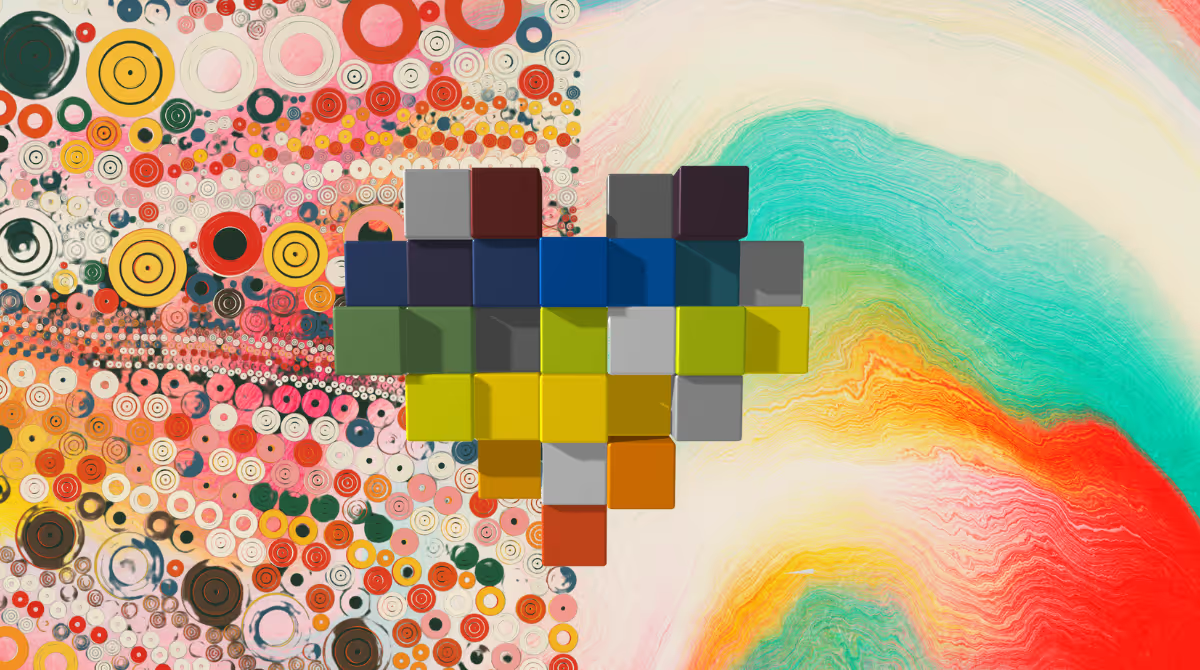

Generative art is transforming how we experience both technology and creativity in the same way that railroads once changed how quickly people could transport around the world. Ideas that once took years to execute now take minutes. Whereas before, artists viewed technology as a tool for their creative expression, today we’re learning to see generative code as a collaborator that can execute our vision through an autonomous system.
Using algorithms to generate unique digital works, non-fungible tokens (NFTs) featuring generative artwork makes us rethink our connection to nature, memory, and change. Artists like Olga Fradina and Per Kristian Stoveland are at the forefront of this movement, combining code with themes that make you question your place in the world. While these collections deliver stunning visuals, they also offer new ways to explore the relationship between technology and human experience.
As those in web3 know, art helps guide its viewers along the bleeding edge of innovation in delightful and sensory ways. Art creates an emotional connection and intellectual intrigue with the subject matter. Perhaps more than any other art form, digital art — and generative art in particular — asks us to reflect upon the ephemeral nature of existence and our relationship to technology in a highly connected world.
Ahead, we feature a list of thought-provoking generative art NFTs minted in 2023, a standout year of innovation. Whether you’re a seasoned collector or new to the web3 art world, enjoy comparing this list to the NFTs in your own crypto wallet, and maybe discover something new.
Olga Fradina’s ‘Naïve’
Naïve, a generative art project by Ukrainian artist and interior designer Olga Fradina, is a breathtaking expression of raw emotion with technical precision. In an interview with generative art platform ArtBlocks, Fradina describes the collection as encapsulating the essence of intuitive child’s play while drawing from the traditions of folk art and Ukrainian primitivists like Maria Primachenko, whose work explores both the terror and whimsy latent within a child’s imagination. This collection is a prime example of code art, showcasing how algorithms and computer programming can create complex artistic works. Additionally, it highlights the significance of computer art, tracing its roots back to pioneers like Frieder Nake and encompassing broader categories such as generative, algorithmic, and procedural art. The collection contains 300 works, utilizing computer graphics to achieve visual complexity and abstract geometries. It originally dropped on ArtBlocks on November 22, 2023.
Snowfro/Jordan Lyall’s ‘Heart + Craft’
On August 24, 2023, Erick “Snowfro” Calderon and Jordan Lyall, collaborated to create Heart + Craft. The collection uniquely blends digital art with physical craftsmanship and spreads positivity through colorful, 3D-printed heart-shaped installations that accompany the NFTs. Considered a generative art drop, the hearts are algorithmically formed and come with detailed instructions for 3D printing, painting, and assembling. Owners can create their own physical heart sculptures, thereby enhancing the collector’s interactive connection to the piece.
‘QQL’ by Tyler Hobbs and Dandelion Wist
Generative art project QQL is a collaboration between Tyler Hobbs, a leading generative artist known for the geometrically styled Fidenza collection, and Dandelion Wist, founder of generative art marketplace Archipelago.
The project kicked off in the spring with a physical exhibition at New York City’s Pace Gallery from March 30 to April 22. The show featured large-scale paintings of digital works created by Hobbs’ algorithm.
Then, on September 19, the pair launched a website where participants could create generative art through the proprietary algorithm and customize it according to their unique preferences such as color, shapes, and repetition of elements. The website was open to the public and served as a space for “intuitive play,” according to the description over at Pace Gallery, where the physical artwork was debuted. Over 5.4 million unique combinations of artwork have been created on the website.
Those who wanted, entered their work into a special contest to receive one of 999 mint passes to collect an NFT. Anonymous judges selected nine winners to get a mint pass. Hobbs and Wist then curated their three favorite contest entries to immortalize in the collection.
Emily Xie’s ‘Interwoven’
Generative artist Emily Xie unveiled her new digital series, Interwoven, in June 2023. The project was a collaboration between Xie and Los Angeles County Museum of Art (LACMA) as Volume 4 of the institution’s digital art initiative, Remembrance of Things Future. Inspired by quilts and textiles, Xie’s collection features 100 unique pieces minted on the Ethereum blockchain. Her work has gained significant attention, rising to an impressive floor price of 3.5 ETH while exploring the intersection of traditional quilting practices and modern art.
According to the collection’s official description, Interwoven meditates on the tension between what’s computational and what’s handmade. The works are made entirely with Xie’s own code but are inspired by an 1896 textile called the Bullseye Quilt, which hangs in LACMA’s collection. If the figures seem creature-like, that’s intentional. Xie wanted to explore the narrative elements of quilt-making traditions, inspiring observers to create meaning from what’s evoked within the imagination.
Melissa Wiederrecht’s ‘Bakhoor Assandal’
Bakhoor Assandal, an animated generative art series by Melissa Weiderrecht, an American-born artist based in Mecca, Saudi Arabia, explores the themes of constant change. Inspired by the ephemeral nature of Sudanese sandalwood incense, the artwork has a smoky, ethereal quality, like a fading memory. Originally released on ArtBlocks in October 2023, the collection explores nature’s ability to regenerate after war and violence, asking in an accompanying poem:
If all the displaced Sudanese people are able to hold onto their memories /
treasure them, and someday bring them back to Omdurman /
Can Sudan be regenerated ... like a forest after a wildfire … /
perhaps stronger and less broken than it was before?
Amber Vittoria’s ‘Figments’
On October 5, 2023, New York-based visual artist Amber Vittoria launched her first solo generative collection, “Figments.” It is a celebration of thought — particularly the fleeting ones. Only available for 48 hours, the collection featured a unique interactive element based on the time of minting. Pieces minted in the night time have darker backgrounds, which represent the dreamscape, while works minted during daylight have lighter backgrounds. The number of circles in each piece also reflects the number of artworks minted within a single transaction, which is meant to symbolize the cumulative nature of thoughts and dreams.
Per Kristian Stoveland’s ‘The Harvest’
Released on ArtBlocks in January 2023, The Harvest by Per Kristian Stoveland is a mesmerizing collection of generative AI art that evokes the story of a millennia-old entity described by the artist as “the Caretaker.” This generative artwork highlights the significance of modern art in fostering creativity, collaboration, and connection between collectors and artists. The artwork tells a story of this Caretaker’s stirring after a long slumber, arousing its “minions” into the vast expanse of the sky to renew the cosmic cycle of replenishment.
But beyond Stoveland’s esoteric lore, the colorful and precise artwork evokes thoughts of extraterrestrial, yet familiar, landscapes. The vibrant colors and geometric lines are both organic and striking. The eye never tires of taking in this collection’s scenes. To top it off, allegedly 25% of proceeds support the Kwa Mutisya Primary School water project in Kenya.
Exploring the intersection of technology and art
The intersection of technology and art has ushered in a new era of creativity, where generative artists are at the forefront of this exciting movement. By leveraging algorithms and machine learning, these artists create unique and dynamic visual art that pushes the boundaries of what is possible. The precision of technology combined with the boundless creativity of art has given rise to generative artworks that are as intricate as they are captivating.
One of the most remarkable aspects of generative art is its ability to produce complex and elaborate architectural patterns that would be nearly impossible to achieve by hand. This has led to the development of new styles and techniques, as artists explore the endless possibilities of algorithmic art and synthetic media. The use of autonomous systems in generative art also raises fascinating questions about the creation process. Is the machine merely a tool, or can it be considered a co-creator, or even the sole creator, of the artwork? These questions challenge our traditional notions of authorship and creativity, making generative art a thought-provoking and revolutionary field.
The power of generative art to inspire and educate
Generative art is not only a feast for the eyes but also a powerful tool for inspiration and education. By making the code and algorithms behind their artworks accessible, generative artists foster a culture of collaboration and innovation. This transparency allows others to learn from their techniques and experiment with their own creations.
Moreover, generative art can be an invaluable educational resource. It can illustrate complex mathematical concepts like fractals and geometry in a visually engaging and interactive way. Data visualization is another area where generative art shines, transforming abstract numbers into comprehensible and aesthetically pleasing patterns. By leveraging the power of generative art, educators can create compelling learning experiences that inspire students to delve into the fascinating intersection of technology and art.
The future of generative art NFTs
The advent of generative art NFTs has opened up a world of possibilities for artists, collectors, and enthusiasts. By creating unique and verifiable digital artworks, generative artists can now monetize their creations in ways that were previously unimaginable. Blockchain technology ensures a secure and transparent buying and selling of these digital items, fostering a sense of trust and community among collectors and artists.
As the market for generative art NFTs continues to expand, we can anticipate even more innovative applications of this technology. Generative artists may begin to explore new forms of interactive and immersive art, utilizing virtual and augmented reality to create experiences that are both unique and engaging. The integration of AI and machine learning in generative art NFTs will likely lead to the development of new styles and techniques, as artists push the boundaries of algorithmic art and synthetic media. The future of generative art NFTs is bright, encouraging the continuous evolution of this captivating and transformative art form.



.avif)
.png)
.png)
.png)
.png)
.png)
.png)
.png)
.png)