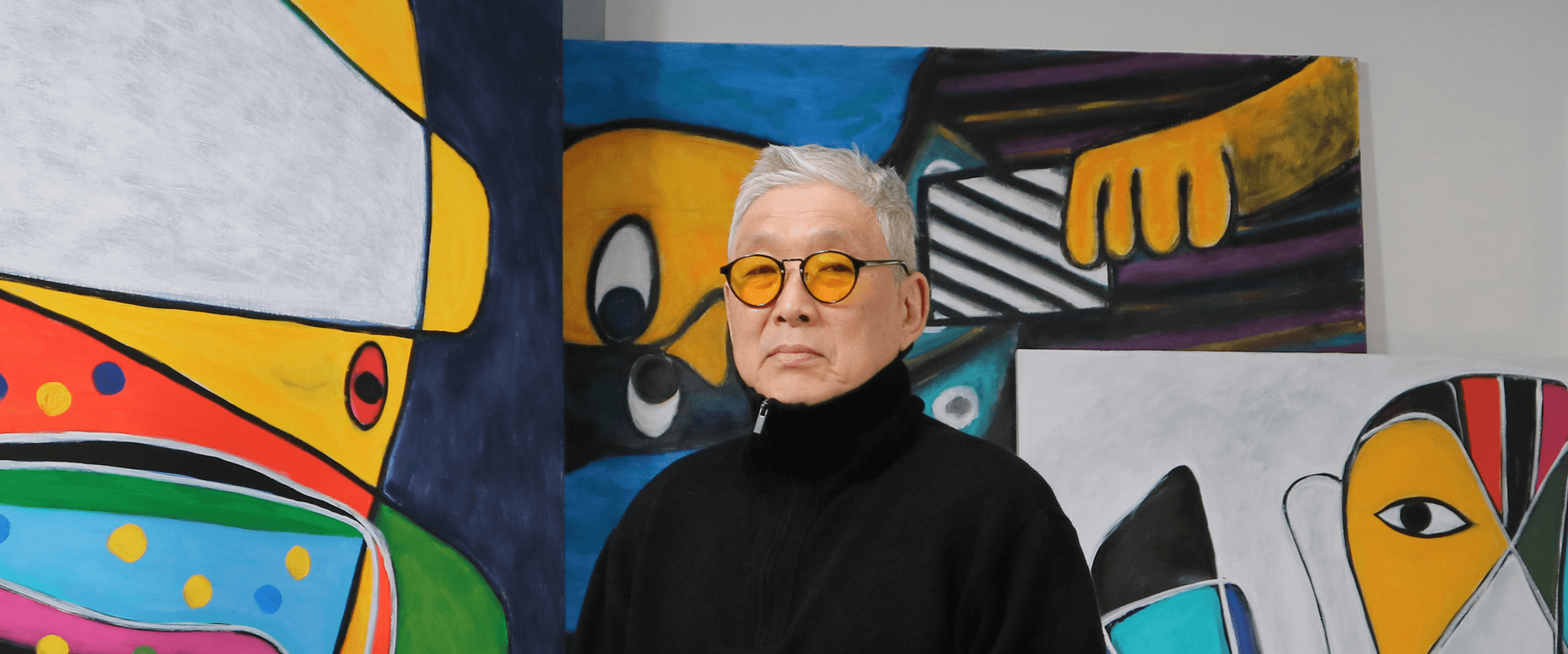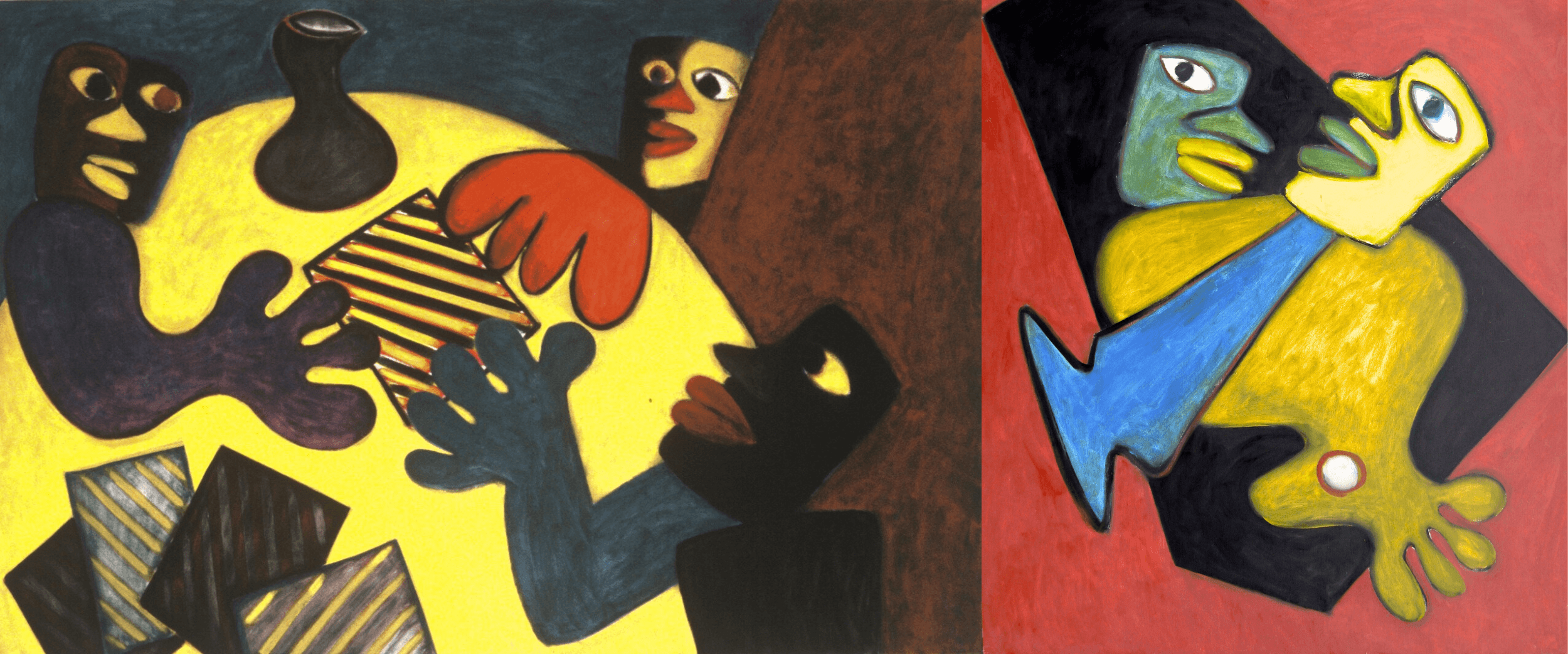
Chae’s breakout exhibition in 1986, Medieval Tales, was a love letter to the lore of centuries past and a test of his artistic ability to convey his passion for literature on canvas. Harnessing his brush like a sword and referencing everything from Arthurian legends to the writings of magical realists Italo Calvino and Anthony Burgess, Chae had emerged as a direct contender against the “edgy” art styles that had become trendy in the East Village of the 1980s.
Like characters in a play, the subjects of this series—kings, queens, jesters, knights—seem to appear as apparitions amidst a shifting background that is intentionally flattened in the style of the Middle Ages. By ignoring the conventions of perspective and emphasis on realism that developed during the Renaissance, Chae succeeds in creating a tension that magnifies the subject of his work and casts the canvas as an isolated realm where science and reason have not yet solidified.
The theatrically rendered protagonists that inhabit this world are not “real” in the physical sense, nor do they pretend to be. They are steeped in symbolism, existing only through our collective folklore, imagination, and artistic interpretations. Although separated by time and distance, Medieval Tales succeeded in bringing the fantasy of these far-away places and to life, and through the use of exaggeration, Chae leaves the mystery of these magical worlds intact, urging his audience to dive a little deeper, and travel a little farther, to find their own truths in his art.
Chae’s breakout exhibition in 1986, Medieval Tales, was a love letter to the lore of centuries past and a test of his artistic ability to convey his passion for literature on canvas. Harnessing his brush like a sword and referencing everything from Arthurian legends to the writings of magical realists Italo Calvino and Anthony Burgess, Chae had emerged as a direct contender against the “edgy” art styles that had become trendy in the East Village of the 1980s.
Like characters in a play, the subjects of this series—kings, queens, jesters, knights—seem to appear as apparitions amidst a shifting background that is intentionally flattened in the style of the Middle Ages. By ignoring the conventions of perspective and emphasis on realism that developed during the Renaissance, Chae succeeds in creating a tension that magnifies the subject of his work and casts the canvas as an isolated realm where science and reason have not yet solidified.
The theatrically rendered protagonists that inhabit this world are not “real” in the physical sense, nor do they pretend to be. They are steeped in symbolism, existing only through our collective folklore, imagination, and artistic interpretations. Although separated by time and distance, Medieval Tales succeeded in bringing the fantasy of these far-away places and to life, and through the use of exaggeration, Chae leaves the mystery of these magical worlds intact, urging his audience to dive a little deeper, and travel a little farther, to find their own truths in his art.