OpenSea Mobile is live: Trade everything, together.
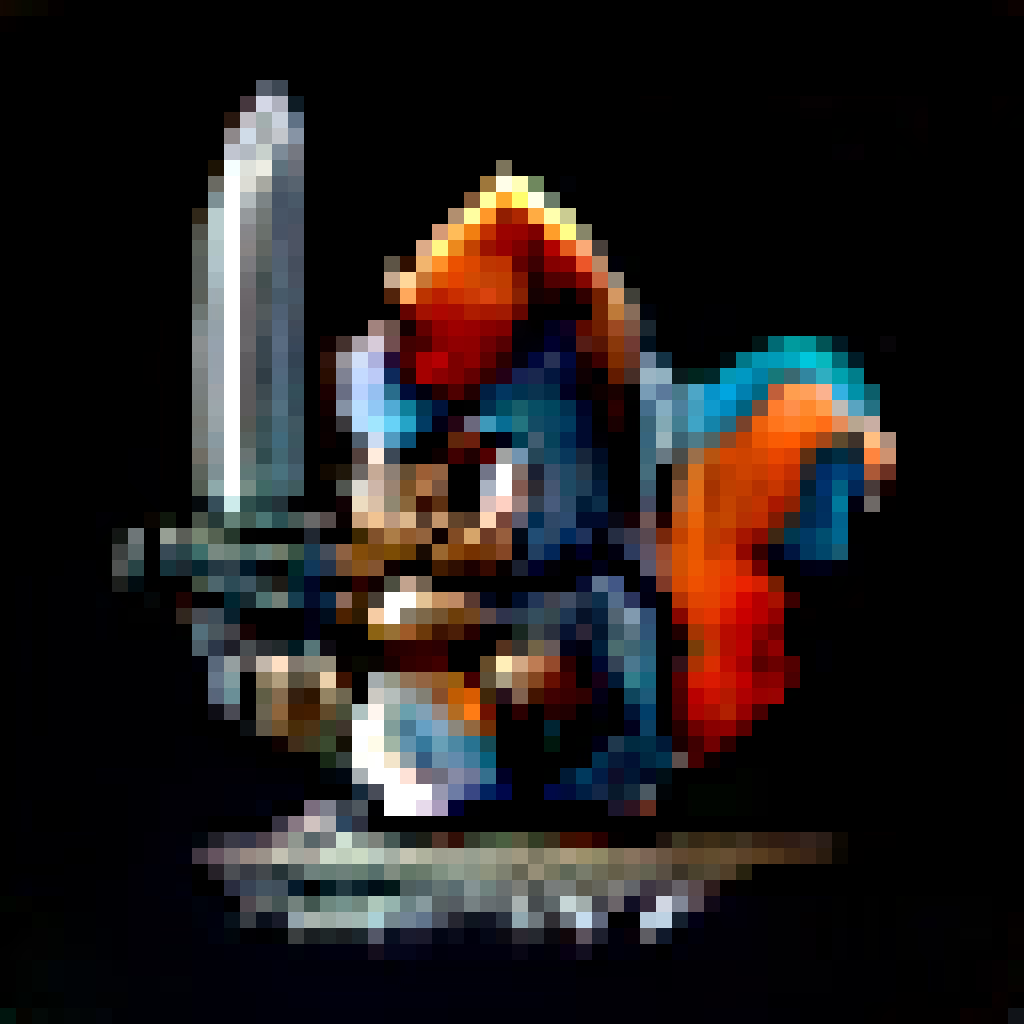
NFTs rely on the cryptographic security of public blockchain networks for properties like traceable provenance and ownership. This is what gives us the ability to "own" digital data, and by extension, gives them value.
When it comes to AI generated art, however, the full extent of the provenance paradigm is currently unfulfilled. Until zkMon, AI art had to be created fully off-chain, then brought on-chain manually — despite the art generation process being digitally native. This means that, until now, outputs generated from an AI artist could never have been cryptographically linked to that original art model.
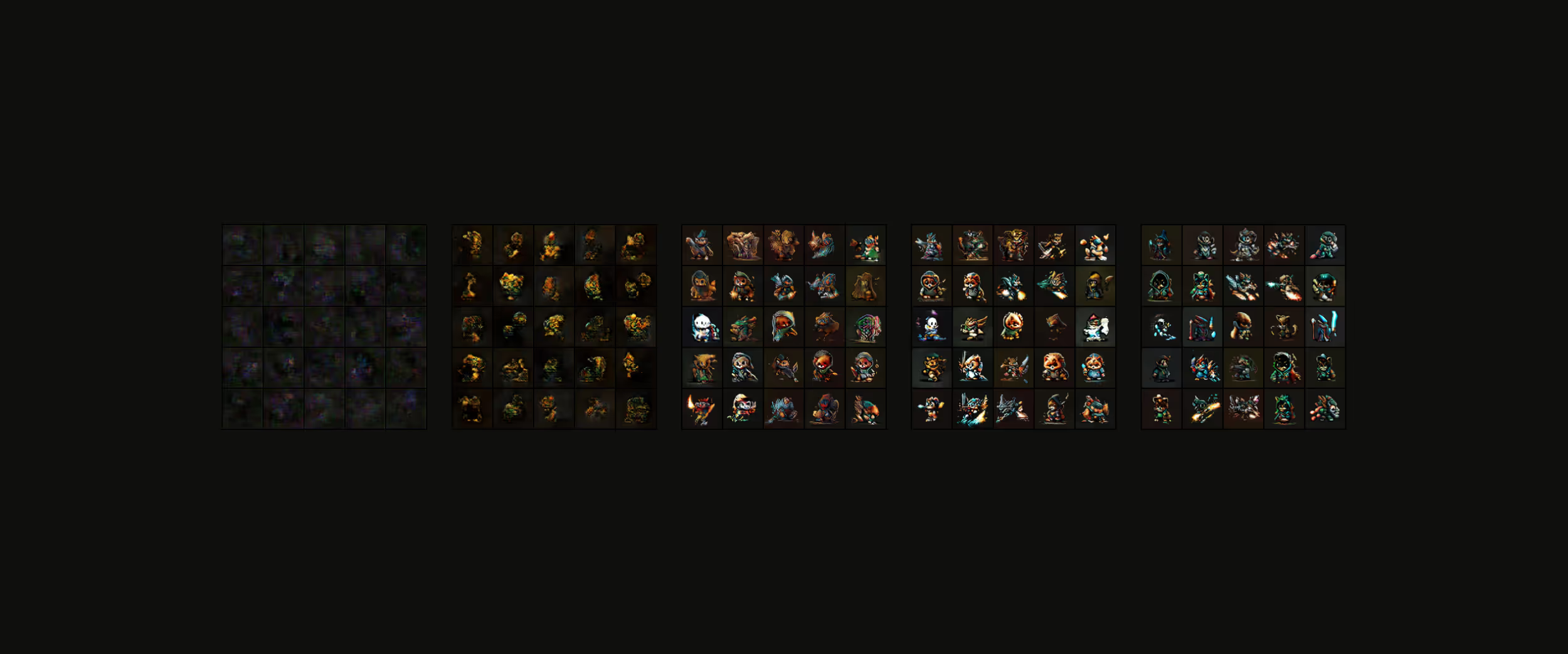
The architecture of the generator is an upsampling convolutional network, complete with residual blocks and classic 3x3 convolutional filters all throughout.
The overall training pipeline follows that of SNGAN, using the spectral norm as a regularization parameter on the discriminator–an alternative way of approximating the Lipshitz constraint introduced in the foundational WGAN work.
For more details, including training hyperparameters and samples, see the zkMon code repo.
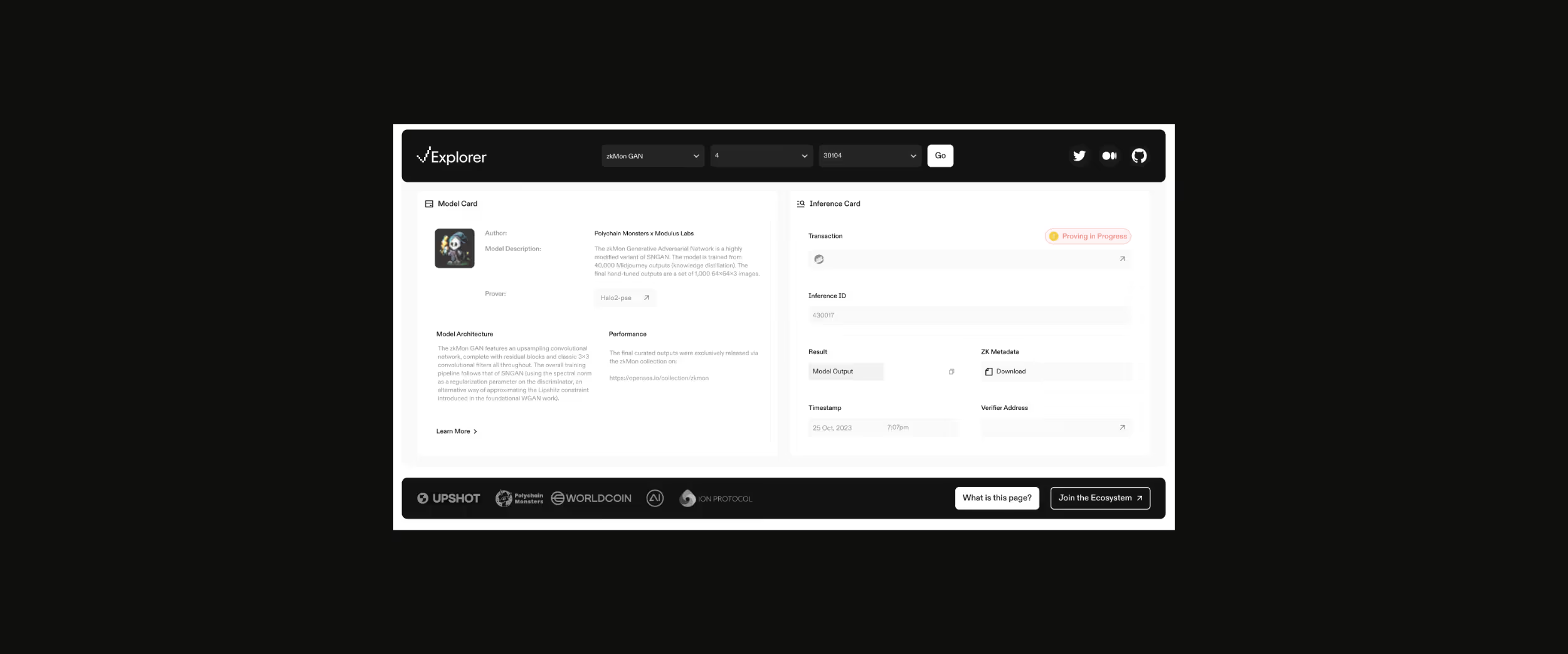
The Modulus Explorer (link to come!) is an AI verification dashboard. Built as a marriage between traditional indexers and analytics dashboards, the Explorer surfaces both on-chain verification details specific to a particular AI output–like the zero-knowledge proofs and records of an AI artist–as well as rich information about the model which powered the result. It’s like a "Nutrition Facts" label, but for verified AI outputs.
With zkML, an AI model can be executed off-chain and proven on-chain according to certain rules, like the version of the AI model, the configuration, training data, etc. Imagine a monster collectible whose visual representation not only evolves but whose character develops through AI, influenced by on-chain inputs. With zkML, your collectible could effectively "live", mutate, and develop a unique personality without any centralized control, secured by the decentralization of Ethereum and cryptography.
zkMon symbolizes humanity's initial efforts to craft an autonomous AI artist. By owning it, you hold a piece of its provenance. This collection blends educational, technological, and futuristic elements, representing AI culture.
Over 30,000 pixel creatures have been skillfully generated by Midjourney, forming an extraordinary initial training dataset. These creations were meticulously refined through more than 30 hours of training on V100 GPUs, spanning 1,000 epochs, ensuring unmatched generative finesse. Out of over 10,000 generations, our founders have selectively handpicked the top 1,000, presenting only the pinnacle of AI-generated output.
The art itself (image data) is not currently on-chain. However, it can be regenerated at any time by running the underlying AI model. We've designed the contract to be upgradeable for a period after its initial deployment. If holders express a desire to have the art persistently stored on-chain, we plan to introduce a function to upload the image data for each monster. In the long run, our goal is to burn the upgrade role to ensure maximum decentralization of the collection.
zkML is an exciting confluence of zero-knowledge proof cryptography (ZK) and artificial intelligence (AI). Zero-knowledge proofs facilitate the confirmation of a statement’s validity without revealing its content or the method used to unearth the truth. Within web3, zero-knowledge proofs play a crucial role in scaling blockchains like Ethereum, which are typically slow and expensive at the base layer.
Large computations executed on-chain, on Ethereum for instance, are gas-intensive and might even surpass block gas limits. This is where zkML can be an absolute game-changer. Complex computations can be performed off-chain, with only a zk proof of the computation brought on-chain. Ethereum validators check the validity of the proof, effectively ensuring that the off-chain computation benefits from Ethereum’s decentralization.
Translating this to AI, it’s currently impossible to run an AI model directly on Ethereum. But what if you could simply prove that you’ve executed a specific AI model? The AI then inherits the security of Ethereum validation, or in simpler terms, becomes "on-chain".
Yes, a portion of 20 NFTs will be reserved and distributed to our team.
The allowlist is reserved for core community members of Polychain Monsters and Modulus Labs. Both Polychain Monsters and Modulus Labs will post information about the allowlisting on their Discord servers. Some allowlist spots might be raffled on X (Twitter).
~24 hours after mint has ended.
Yes. Gas fees occur for any transaction or attempted transaction on the blockchain including a mint. The amount will vary depending on a variety of factors such as how many people are using the network at that moment. OpenSea does not control gas prices, nor does it receive or profit from them, and OpenSea is not able to refund gas fees. You'll pay gas fees even if you weren't able to successfully mint.

Protocol Monster Labs (https://protocolmonsterlabs.com/) is a collectibles company that has been crafting monster NFTs since 2021. With a mission to create fully autonomous monster collectibles that boast Ethereum-grade security and longevity, zkMon takes its initial step into an AI-collaborated world.
While autonomous collectibles are part of their long-term vision, Protocol Monster Labs is currently developing a fully on-chain battle game on Ethereum L2s. The team holds a strong belief in an on-chain future.

Modulus is the accountable magic company (http://modulus.xyz). They use bleeding-edge, specialized cryptography to verify that AI results weren’t secretly manipulated. This means that the blockchain can now access AI features without abandoning the trustless creed. The team is based in Stanford, California.
Modulus is the accountable magic company (http://modulus.xyz). They use bleeding-edge, specialized cryptography to verify that AI results weren’t secretly manipulated. This means that the blockchain can now access AI features without abandoning the trustless creed. The team is based in Stanford, California.
NFTs rely on the cryptographic security of public blockchain networks for properties like traceable provenance and ownership. This is what gives us the ability to "own" digital data, and by extension, gives them value.
When it comes to AI generated art, however, the full extent of the provenance paradigm is currently unfulfilled. Until zkMon, AI art had to be created fully off-chain, then brought on-chain manually — despite the art generation process being digitally native. This means that, until now, outputs generated from an AI artist could never have been cryptographically linked to that original art model.
The architecture of the generator is an upsampling convolutional network, complete with residual blocks and classic 3x3 convolutional filters all throughout.
The overall training pipeline follows that of SNGAN, using the spectral norm as a regularization parameter on the discriminator–an alternative way of approximating the Lipshitz constraint introduced in the foundational WGAN work.
For more details, including training hyperparameters and samples, see the zkMon code repo.
The Modulus Explorer (link to come!) is an AI verification dashboard. Built as a marriage between traditional indexers and analytics dashboards, the Explorer surfaces both on-chain verification details specific to a particular AI output–like the zero-knowledge proofs and records of an AI artist–as well as rich information about the model which powered the result. It’s like a "Nutrition Facts" label, but for verified AI outputs.
With zkML, an AI model can be executed off-chain and proven on-chain according to certain rules, like the version of the AI model, the configuration, training data, etc. Imagine a monster collectible whose visual representation not only evolves but whose character develops through AI, influenced by on-chain inputs. With zkML, your collectible could effectively "live", mutate, and develop a unique personality without any centralized control, secured by the decentralization of Ethereum and cryptography.
zkMon symbolizes humanity's initial efforts to craft an autonomous AI artist. By owning it, you hold a piece of its provenance. This collection blends educational, technological, and futuristic elements, representing AI culture.
Over 30,000 pixel creatures have been skillfully generated by Midjourney, forming an extraordinary initial training dataset. These creations were meticulously refined through more than 30 hours of training on V100 GPUs, spanning 1,000 epochs, ensuring unmatched generative finesse. Out of over 10,000 generations, our founders have selectively handpicked the top 1,000, presenting only the pinnacle of AI-generated output.
The art itself (image data) is not currently on-chain. However, it can be regenerated at any time by running the underlying AI model. We've designed the contract to be upgradeable for a period after its initial deployment. If holders express a desire to have the art persistently stored on-chain, we plan to introduce a function to upload the image data for each monster. In the long run, our goal is to burn the upgrade role to ensure maximum decentralization of the collection.
zkML is an exciting confluence of zero-knowledge proof cryptography (ZK) and artificial intelligence (AI). Zero-knowledge proofs facilitate the confirmation of a statement’s validity without revealing its content or the method used to unearth the truth. Within web3, zero-knowledge proofs play a crucial role in scaling blockchains like Ethereum, which are typically slow and expensive at the base layer.
Large computations executed on-chain, on Ethereum for instance, are gas-intensive and might even surpass block gas limits. This is where zkML can be an absolute game-changer. Complex computations can be performed off-chain, with only a zk proof of the computation brought on-chain. Ethereum validators check the validity of the proof, effectively ensuring that the off-chain computation benefits from Ethereum’s decentralization.
Translating this to AI, it’s currently impossible to run an AI model directly on Ethereum. But what if you could simply prove that you’ve executed a specific AI model? The AI then inherits the security of Ethereum validation, or in simpler terms, becomes "on-chain".
Yes, a portion of 20 NFTs will be reserved and distributed to our team.
The allowlist is reserved for core community members of Polychain Monsters and Modulus Labs. Both Polychain Monsters and Modulus Labs will post information about the allowlisting on their Discord servers. Some allowlist spots might be raffled on X (Twitter).
~24 hours after mint has ended.
Yes. Gas fees occur for any transaction or attempted transaction on the blockchain including a mint. The amount will vary depending on a variety of factors such as how many people are using the network at that moment. OpenSea does not control gas prices, nor does it receive or profit from them, and OpenSea is not able to refund gas fees. You'll pay gas fees even if you weren't able to successfully mint.
Protocol Monster Labs (https://protocolmonsterlabs.com/) is a collectibles company that has been crafting monster NFTs since 2021. With a mission to create fully autonomous monster collectibles that boast Ethereum-grade security and longevity, zkMon takes its initial step into an AI-collaborated world.
While autonomous collectibles are part of their long-term vision, Protocol Monster Labs is currently developing a fully on-chain battle game on Ethereum L2s. The team holds a strong belief in an on-chain future.
Modulus is the accountable magic company (http://modulus.xyz). They use bleeding-edge, specialized cryptography to verify that AI results weren’t secretly manipulated. This means that the blockchain can now access AI features without abandoning the trustless creed. The team is based in Stanford, California.
Modulus is the accountable magic company (http://modulus.xyz). They use bleeding-edge, specialized cryptography to verify that AI results weren’t secretly manipulated. This means that the blockchain can now access AI features without abandoning the trustless creed. The team is based in Stanford, California.