OpenSea Mobile is live: Trade everything, together.
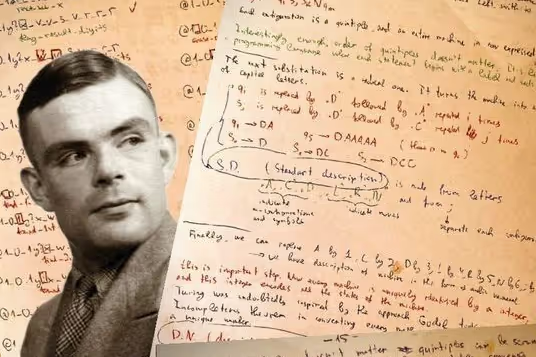
Created in summer 2017, this machine is a labor of love and intellectual curiosity. The process involved:
*Transitioning from Digital to Analogue: Initially conceived as a digital project, I quickly switched to pen and paper due to the limitations of standard keyboard layouts for representing specialized mathematical symbols.
*Exploring the Depths of Mathematics: The project required deep dives into number theory and computability theory, exploring concepts I had never encountered before.
*An Intuitive "Execution Log": The collection inherently captures the machine's execution log, a concept intuitively grasped by the author during the creation process.
It is more than just art. It's a piece of:
*Computer Science History: A tangible representation of a foundational concept in computer science.
Mathematical Exploration: A visual journey through complex mathematical ideas.
Intellectual Artifact: A testament to the power of human curiosity and problem-solving, mirroring Turing's own quest to address Hilbert's 10th problem.
Created in summer 2017, this machine is a labor of love and intellectual curiosity. The process involved:
*Transitioning from Digital to Analogue: Initially conceived as a digital project, I quickly switched to pen and paper due to the limitations of standard keyboard layouts for representing specialized mathematical symbols.
*Exploring the Depths of Mathematics: The project required deep dives into number theory and computability theory, exploring concepts I had never encountered before.
*An Intuitive "Execution Log": The collection inherently captures the machine's execution log, a concept intuitively grasped by the author during the creation process.
It is more than just art. It's a piece of:
*Computer Science History: A tangible representation of a foundational concept in computer science.
Mathematical Exploration: A visual journey through complex mathematical ideas.
Intellectual Artifact: A testament to the power of human curiosity and problem-solving, mirroring Turing's own quest to address Hilbert's 10th problem.
This Turing machine calculates the square root of 2 in binary. Inspired by Charles Petzold's 'Annotated Turing,' I sought to emulate Alan Turing's original style, designing this theoretical model of computation using pen and paper in the summer of 2017. Initially, I attempted a digital approach but soon transitioned to pen and paper due to the limitations of standard keyboard layouts for representing specialized symbols. The project involved deep diving into different fields of mathematics, i.e. number theory and computability theory. Many of these topics I encountered for the first time in my life - perhaps, it was the main reason for some anecdotal issues related to my working. While teaching at the summer school, after this work had been finalized, I had an opportunity to showcase these handwritten sheets to a couple of Russian mathematicians. One of them, Andrey Bremzen (formerly a professor at New Economics School in Moscow, R.I.P.), proclaimed while observing a bulk of paper sheets: "It definitely seems to be the infinite type lent!". Andrey had a brilliant sense of humour, but at the moment I didn't understand the joke referring to the extensive amount of paper used. The other mathematician, Ilya Shurov, formerly professor at HSE, nowadays professor at Radboud University, while observing these strange papers, asked astonishingly: 'What is that? Is that the execution log? I couldn't answer this question as I simply did not know the term 'execution log' at that moment. Well, yes, in the process of my work I intuitively captured the execution log of the machine before even knowing this term - and it's normal. Alan Turing never intended to create a theoretical artificial intelligence capable of implementing any possible task. In fact, all his endeavour was not more than a brilliant attempt to either prove or disprove Hilbert's 10th problem. Driven by curiosity, he worked passionately. Curiosity was his main incentive, so it was for me as well. When Ilya asked me about my personal reasons behind this work, I answered honestly that I had a bit of free time that summer and I was just curious. Seven years later, inspired by the growing interest in intellectual and educational NFTs, I've decided to publish my work as an NFT collection, preserving its original form and sharing the story behind its creation.
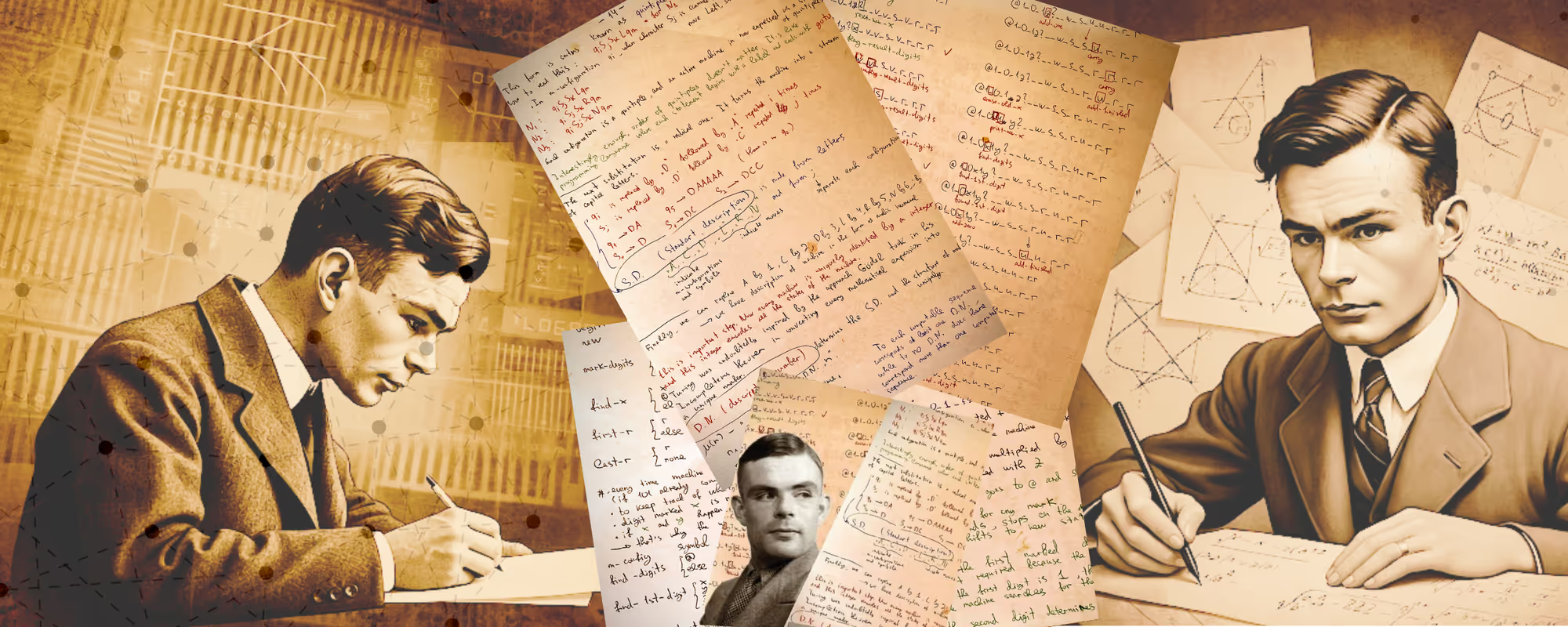
Created in summer 2017, this machine is a labor of love and intellectual curiosity. The process involved:
*Transitioning from Digital to Analogue: Initially conceived as a digital project, I quickly switched to pen and paper due to the limitations of standard keyboard layouts for representing specialized mathematical symbols.
*Exploring the Depths of Mathematics: The project required deep dives into number theory and computability theory, exploring concepts I had never encountered before.
*An Intuitive "Execution Log": The collection inherently captures the machine's execution log, a concept intuitively grasped by the author during the creation process.
It is more than just art. It's a piece of:
*Computer Science History: A tangible representation of a foundational concept in computer science.
Mathematical Exploration: A visual journey through complex mathematical ideas.
Intellectual Artifact: A testament to the power of human curiosity and problem-solving, mirroring Turing's own quest to address Hilbert's 10th problem.
Created in summer 2017, this machine is a labor of love and intellectual curiosity. The process involved:
*Transitioning from Digital to Analogue: Initially conceived as a digital project, I quickly switched to pen and paper due to the limitations of standard keyboard layouts for representing specialized mathematical symbols.
*Exploring the Depths of Mathematics: The project required deep dives into number theory and computability theory, exploring concepts I had never encountered before.
*An Intuitive "Execution Log": The collection inherently captures the machine's execution log, a concept intuitively grasped by the author during the creation process.
It is more than just art. It's a piece of:
*Computer Science History: A tangible representation of a foundational concept in computer science.
Mathematical Exploration: A visual journey through complex mathematical ideas.
Intellectual Artifact: A testament to the power of human curiosity and problem-solving, mirroring Turing's own quest to address Hilbert's 10th problem.
This Turing machine calculates the square root of 2 in binary. Inspired by Charles Petzold's 'Annotated Turing,' I sought to emulate Alan Turing's original style, designing this theoretical model of computation using pen and paper in the summer of 2017. Initially, I attempted a digital approach but soon transitioned to pen and paper due to the limitations of standard keyboard layouts for representing specialized symbols. The project involved deep diving into different fields of mathematics, i.e. number theory and computability theory. Many of these topics I encountered for the first time in my life - perhaps, it was the main reason for some anecdotal issues related to my working. While teaching at the summer school, after this work had been finalized, I had an opportunity to showcase these handwritten sheets to a couple of Russian mathematicians. One of them, Andrey Bremzen (formerly a professor at New Economics School in Moscow, R.I.P.), proclaimed while observing a bulk of paper sheets: "It definitely seems to be the infinite type lent!". Andrey had a brilliant sense of humour, but at the moment I didn't understand the joke referring to the extensive amount of paper used. The other mathematician, Ilya Shurov, formerly professor at HSE, nowadays professor at Radboud University, while observing these strange papers, asked astonishingly: 'What is that? Is that the execution log? I couldn't answer this question as I simply did not know the term 'execution log' at that moment. Well, yes, in the process of my work I intuitively captured the execution log of the machine before even knowing this term - and it's normal. Alan Turing never intended to create a theoretical artificial intelligence capable of implementing any possible task. In fact, all his endeavour was not more than a brilliant attempt to either prove or disprove Hilbert's 10th problem. Driven by curiosity, he worked passionately. Curiosity was his main incentive, so it was for me as well. When Ilya asked me about my personal reasons behind this work, I answered honestly that I had a bit of free time that summer and I was just curious. Seven years later, inspired by the growing interest in intellectual and educational NFTs, I've decided to publish my work as an NFT collection, preserving its original form and sharing the story behind its creation.
