I. Geometry & Symmetry (1–20) II. Physics & Energy (21–40) III. Relativity & Quantum (41–60) IV. Chaos & Fractals (61–80) V. Logic, Computation & AI (81–100) VI. Probability & Statistics (101–120) VII. Topology & Abstract Geometry (121–140) VIII. Number Theory & Algebra (141–160) IX. Abstract & Cosmic (161–180) X. Universal & Conceptual (181–200)
Behind every piece in my collection lies a formula. Not a concept. Not an impression. A verifiable formula — from number theory to chaos.

limxto∞f(x)=L\lim_{x \to \infty} f(x) = Llimxto∞f(x)=L Theme: Infinity. The glowing horizon of convergence. Palette: Violet–Electric Blue Symbolism: Calm within chaos.

y=x2y = x^2y=x2 Theme: Simplicity and growth. Parabolic elegance. Palette: Sunset Orange–Fuchsia Symbolism: Harmony between reflection and ascent.

z=a+biz = a + biz=a+bi Theme: Duality. Real meets imaginary. Palette: Indigo–Crimson Symbolism: The beauty of contradiction.

In the heart of the quantum void, where time folds and gravity sings, Singularity Bloom was born—not from matter, but from pure mathematic formula. It is said to be the first conscious equation, a seed of reality suspended in a cosmic breath. Networks of starlight and magnetic threads swirl around its core, decoding the language of the universe in radiant silence. Formula (Conceptual):E = ∞(Cₗ + T) / G
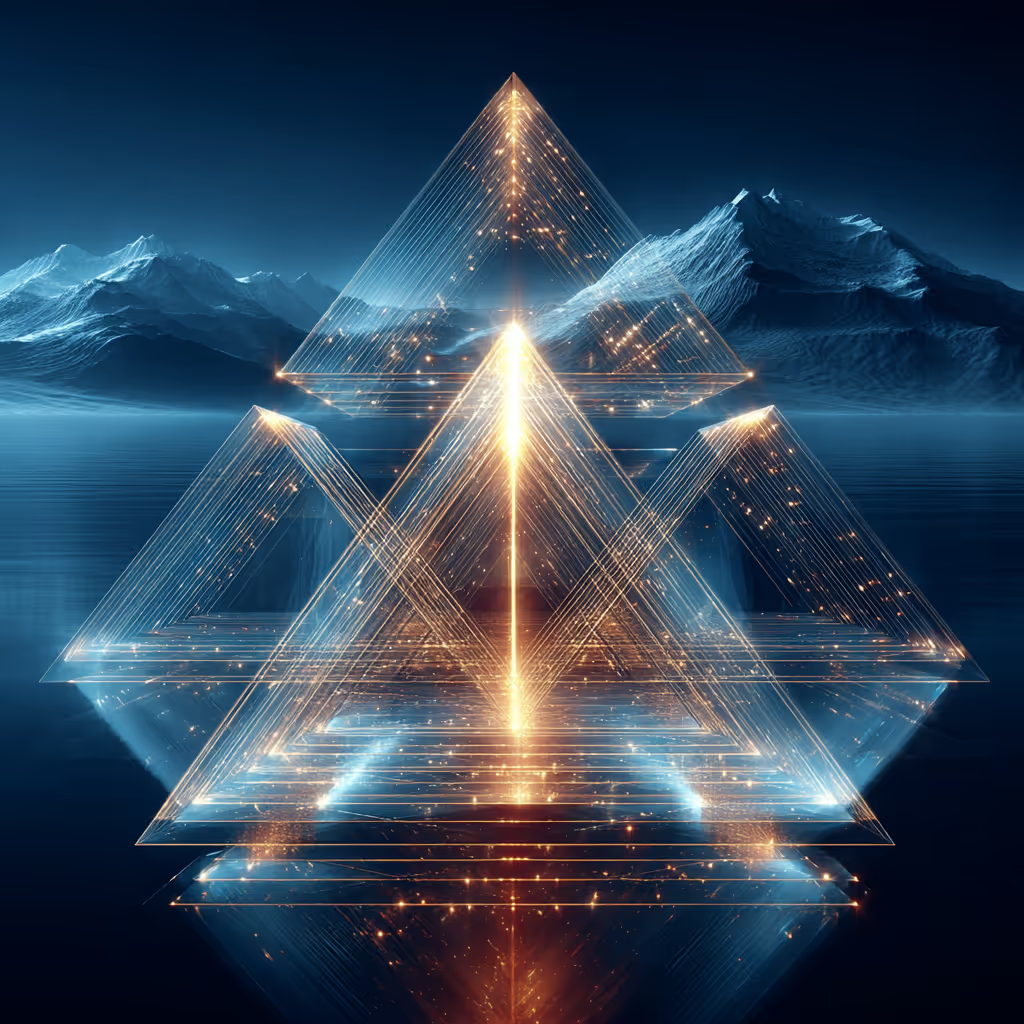

“From one spark, infinite patterns unfold — Pascal’s Triangle reveals the recursive heartbeat of creation.” A piece from Mathematical Realms, where mathematics meets sacred geometry and fractal infinity.

“Where mass becomes light and time bends — Einstein’s formula ignites the very engine of the cosmos.” A piece from Mathematical Realms, blending relativity, light, and creation in one eternal flash.

“When Galileo placed the Sun at the center, he realigned not just the heavens — but human thought itself.” A piece from Mathematical Realms, fusing celestial geometry with the fire of discovery.

“In the eternal triangle of harmony, where logic meets light — Pythagoras’ truth radiates: a² + b² = c².” A piece from Mathematical Realms, blending ancient geometry with cosmic art.

Albert Einstein was a German-born theoretical physicist and mathematician, born in 1879. Though he is most famous for his theories of relativity, his work also has significant implications for the philosophy of science. Einstein's equation E=mc^2 revolutionized our understanding of matter and energy.

Galileo Galilei was an Italian astronomer, physicist, and mathematician born in 1564. While he is most famous for his contributions to astronomy, such as his support for the heliocentric model, he also made significant contributions to mathematics. Galileo laid the groundwork for the concept of kinematics and made advancements in the understanding of material science and the strength of materials. His work in both science and mathematics laid some of the foundations for modern physics.

Blaise Pascal was a French mathematician and physicist born in 1623. He is known for Pascal's Triangle, a way to present binomial coefficients, and for his contributions to the theory of probability. Pascal also made important contributions to fluid mechanics and is the namesake of the unit of pressure, the Pascal. Despite dying at a young age of 39, his work in both mathematics and philosophy has left an enduring legacy.

John Von Neumann was a Hungarian-American mathematician, physicist, and computer scientist, born in 1903. He made significant contributions to quantum mechanics, functional analysis, set theory, economics, and other scientific disciplines. Von Neumann was one of the key figures in the development of game theory and the concept of cellular automata. He also contributed to the development of the first electronic general-purpose computer, the ENIAC.

Pythagoras was an ancient Greek mathematician and philosopher, born around 570 BC. He is best known for the Pythagorean theorem, which relates the sides of a right triangle. Though the theorem was known to Indian mathematicians before him, it bears his name in the Western world. The Pythagorean school he founded studied mathematics, music, and astronomy, and greatly influenced subsequent Western philosophy and religious thought.


I. Geometry & Symmetry (1–20) II. Physics & Energy (21–40) III. Relativity & Quantum (41–60) IV. Chaos & Fractals (61–80) V. Logic, Computation & AI (81–100) VI. Probability & Statistics (101–120) VII. Topology & Abstract Geometry (121–140) VIII. Number Theory & Algebra (141–160) IX. Abstract & Cosmic (161–180) X. Universal & Conceptual (181–200)
Behind every piece in my collection lies a formula. Not a concept. Not an impression. A verifiable formula — from number theory to chaos.

limxto∞f(x)=L\lim_{x \to \infty} f(x) = Llimxto∞f(x)=L Theme: Infinity. The glowing horizon of convergence. Palette: Violet–Electric Blue Symbolism: Calm within chaos.

y=x2y = x^2y=x2 Theme: Simplicity and growth. Parabolic elegance. Palette: Sunset Orange–Fuchsia Symbolism: Harmony between reflection and ascent.

z=a+biz = a + biz=a+bi Theme: Duality. Real meets imaginary. Palette: Indigo–Crimson Symbolism: The beauty of contradiction.

In the heart of the quantum void, where time folds and gravity sings, Singularity Bloom was born—not from matter, but from pure mathematic formula. It is said to be the first conscious equation, a seed of reality suspended in a cosmic breath. Networks of starlight and magnetic threads swirl around its core, decoding the language of the universe in radiant silence. Formula (Conceptual):E = ∞(Cₗ + T) / G

“From one spark, infinite patterns unfold — Pascal’s Triangle reveals the recursive heartbeat of creation.” A piece from Mathematical Realms, where mathematics meets sacred geometry and fractal infinity.

“Where mass becomes light and time bends — Einstein’s formula ignites the very engine of the cosmos.” A piece from Mathematical Realms, blending relativity, light, and creation in one eternal flash.

“When Galileo placed the Sun at the center, he realigned not just the heavens — but human thought itself.” A piece from Mathematical Realms, fusing celestial geometry with the fire of discovery.

“In the eternal triangle of harmony, where logic meets light — Pythagoras’ truth radiates: a² + b² = c².” A piece from Mathematical Realms, blending ancient geometry with cosmic art.

Albert Einstein was a German-born theoretical physicist and mathematician, born in 1879. Though he is most famous for his theories of relativity, his work also has significant implications for the philosophy of science. Einstein's equation E=mc^2 revolutionized our understanding of matter and energy.

Galileo Galilei was an Italian astronomer, physicist, and mathematician born in 1564. While he is most famous for his contributions to astronomy, such as his support for the heliocentric model, he also made significant contributions to mathematics. Galileo laid the groundwork for the concept of kinematics and made advancements in the understanding of material science and the strength of materials. His work in both science and mathematics laid some of the foundations for modern physics.

Blaise Pascal was a French mathematician and physicist born in 1623. He is known for Pascal's Triangle, a way to present binomial coefficients, and for his contributions to the theory of probability. Pascal also made important contributions to fluid mechanics and is the namesake of the unit of pressure, the Pascal. Despite dying at a young age of 39, his work in both mathematics and philosophy has left an enduring legacy.

John Von Neumann was a Hungarian-American mathematician, physicist, and computer scientist, born in 1903. He made significant contributions to quantum mechanics, functional analysis, set theory, economics, and other scientific disciplines. Von Neumann was one of the key figures in the development of game theory and the concept of cellular automata. He also contributed to the development of the first electronic general-purpose computer, the ENIAC.

Pythagoras was an ancient Greek mathematician and philosopher, born around 570 BC. He is best known for the Pythagorean theorem, which relates the sides of a right triangle. Though the theorem was known to Indian mathematicians before him, it bears his name in the Western world. The Pythagorean school he founded studied mathematics, music, and astronomy, and greatly influenced subsequent Western philosophy and religious thought.
I. Geometry & Symmetry (1–20) II. Physics & Energy (21–40) III. Relativity & Quantum (41–60) IV. Chaos & Fractals (61–80) V. Logic, Computation & AI (81–100) VI. Probability & Statistics (101–120) VII. Topology & Abstract Geometry (121–140) VIII. Number Theory & Algebra (141–160) IX. Abstract & Cosmic (161–180) X. Universal & Conceptual (181–200)
Behind every piece in my collection lies a formula. Not a concept. Not an impression. A verifiable formula — from number theory to chaos.

limxto∞f(x)=L\lim_{x \to \infty} f(x) = Llimxto∞f(x)=L Theme: Infinity. The glowing horizon of convergence. Palette: Violet–Electric Blue Symbolism: Calm within chaos.

y=x2y = x^2y=x2 Theme: Simplicity and growth. Parabolic elegance. Palette: Sunset Orange–Fuchsia Symbolism: Harmony between reflection and ascent.

z=a+biz = a + biz=a+bi Theme: Duality. Real meets imaginary. Palette: Indigo–Crimson Symbolism: The beauty of contradiction.

In the heart of the quantum void, where time folds and gravity sings, Singularity Bloom was born—not from matter, but from pure mathematic formula. It is said to be the first conscious equation, a seed of reality suspended in a cosmic breath. Networks of starlight and magnetic threads swirl around its core, decoding the language of the universe in radiant silence. Formula (Conceptual):E = ∞(Cₗ + T) / G

“From one spark, infinite patterns unfold — Pascal’s Triangle reveals the recursive heartbeat of creation.” A piece from Mathematical Realms, where mathematics meets sacred geometry and fractal infinity.

“Where mass becomes light and time bends — Einstein’s formula ignites the very engine of the cosmos.” A piece from Mathematical Realms, blending relativity, light, and creation in one eternal flash.

“When Galileo placed the Sun at the center, he realigned not just the heavens — but human thought itself.” A piece from Mathematical Realms, fusing celestial geometry with the fire of discovery.

“In the eternal triangle of harmony, where logic meets light — Pythagoras’ truth radiates: a² + b² = c².” A piece from Mathematical Realms, blending ancient geometry with cosmic art.

Albert Einstein was a German-born theoretical physicist and mathematician, born in 1879. Though he is most famous for his theories of relativity, his work also has significant implications for the philosophy of science. Einstein's equation E=mc^2 revolutionized our understanding of matter and energy.

Galileo Galilei was an Italian astronomer, physicist, and mathematician born in 1564. While he is most famous for his contributions to astronomy, such as his support for the heliocentric model, he also made significant contributions to mathematics. Galileo laid the groundwork for the concept of kinematics and made advancements in the understanding of material science and the strength of materials. His work in both science and mathematics laid some of the foundations for modern physics.

Blaise Pascal was a French mathematician and physicist born in 1623. He is known for Pascal's Triangle, a way to present binomial coefficients, and for his contributions to the theory of probability. Pascal also made important contributions to fluid mechanics and is the namesake of the unit of pressure, the Pascal. Despite dying at a young age of 39, his work in both mathematics and philosophy has left an enduring legacy.

John Von Neumann was a Hungarian-American mathematician, physicist, and computer scientist, born in 1903. He made significant contributions to quantum mechanics, functional analysis, set theory, economics, and other scientific disciplines. Von Neumann was one of the key figures in the development of game theory and the concept of cellular automata. He also contributed to the development of the first electronic general-purpose computer, the ENIAC.

Pythagoras was an ancient Greek mathematician and philosopher, born around 570 BC. He is best known for the Pythagorean theorem, which relates the sides of a right triangle. Though the theorem was known to Indian mathematicians before him, it bears his name in the Western world. The Pythagorean school he founded studied mathematics, music, and astronomy, and greatly influenced subsequent Western philosophy and religious thought.


