Protoliths originate from a simple concept – picture yourself taking a walk where a coin is flipped with each step to dictate your direction; this is known as a random walk. In this intriguing journey, cubes traverse three dimensions. At each stage, one of the six possible faces is selected using a dice, determining the subsequent cube's position.
We present you with a collection of 9,900 protoliths. Can we expect to encounter two protoliths with the same shape among this vast array? Moreover, can you estimate the number of distinct shapes that coexist in this realm?
Let's think about these questions as we delve into the boundless realm of possibilities and nuances.
The future is all about Virtual Reality (VR). Soon, we'll be working, chatting, and even living in VR spaces. It's important to make these VR places look good and feel real. One way we're doing this is with 3D Protolith, which is bringing these 3D objects into VR. But we're not forgetting the real world. This mix of VR and real-life stuff is going to make our future really interesting. The ultimate phase for selected Protoliths involves bringing these virtual creations to life in tangible forms, allowing us to interact with them physically in our homes, like cherished artifacts placed thoughtfully in the corner of our living rooms. This blend of virtual and physical realities promises a future where technology enhances our living spaces, both digital and real.
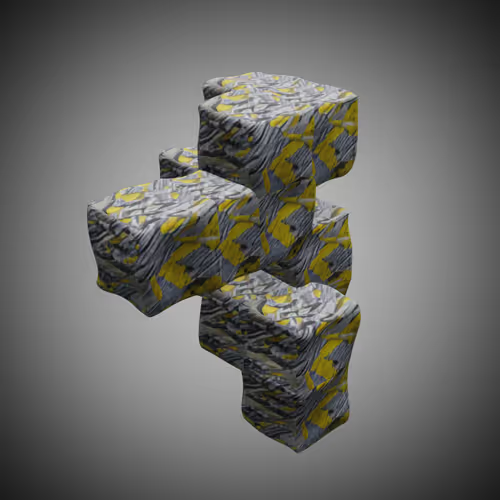
Protoliths originate from a simple concept – picture yourself taking a walk where a coin is flipped with each step to dictate your direction; this is known as a random walk. In this intriguing journey, cubes traverse three dimensions. At each stage, one of the six possible faces is selected using a dice, determining the subsequent cube's position.
We present you with a collection of 9,900 protoliths. Can we expect to encounter two protoliths with the same shape among this vast array? Moreover, can you estimate the number of distinct shapes that coexist in this realm?
Let's think about these questions as we delve into the boundless realm of possibilities and nuances.
The future is all about Virtual Reality (VR). Soon, we'll be working, chatting, and even living in VR spaces. It's important to make these VR places look good and feel real. One way we're doing this is with 3D Protolith, which is bringing these 3D objects into VR. But we're not forgetting the real world. This mix of VR and real-life stuff is going to make our future really interesting. The ultimate phase for selected Protoliths involves bringing these virtual creations to life in tangible forms, allowing us to interact with them physically in our homes, like cherished artifacts placed thoughtfully in the corner of our living rooms. This blend of virtual and physical realities promises a future where technology enhances our living spaces, both digital and real.

Protoliths originate from a simple concept – picture yourself taking a walk where a coin is flipped with each step to dictate your direction; this is known as a random walk. In this intriguing journey, cubes traverse three dimensions. At each stage, one of the six possible faces is selected using a dice, determining the subsequent cube's position.
We present you with a collection of 9,900 protoliths. Can we expect to encounter two protoliths with the same shape among this vast array? Moreover, can you estimate the number of distinct shapes that coexist in this realm?
Let's think about these questions as we delve into the boundless realm of possibilities and nuances.
The future is all about Virtual Reality (VR). Soon, we'll be working, chatting, and even living in VR spaces. It's important to make these VR places look good and feel real. One way we're doing this is with 3D Protolith, which is bringing these 3D objects into VR. But we're not forgetting the real world. This mix of VR and real-life stuff is going to make our future really interesting. The ultimate phase for selected Protoliths involves bringing these virtual creations to life in tangible forms, allowing us to interact with them physically in our homes, like cherished artifacts placed thoughtfully in the corner of our living rooms. This blend of virtual and physical realities promises a future where technology enhances our living spaces, both digital and real.

