.png)
Andrea Chiampo is an Italian digital artist and designer whose practice spans industrial design, entertainment concept art, and fine art. Based in London, Chiampo is best known for FUTURED PAST, an ongoing body of work that uses advanced 3D digital sculpting to create imagery that evokes ancient lithographies and archaeological relics. His work has expanded into physical printmaking, sterling silver sculpture, blockchain systems, and cryptographic performance art.
We sit down with Andrea Chiampo to discuss growing up in Spoleto surrounded by art and history, his path from industrial design to concept art and fine art, his ongoing project FUTURED PAST, and the debut of MATER NATVRA at Zero 10 during Art Basel Miami Beach.
Note: This interview has been edited for length and clarity
OpenSea: You grew up in Spoleto, Italy, surrounded by centuries of artistic tradition, but you were also drawn to science fiction and fantasy. How did those two worlds coexist for you growing up, and do you still feel that tension in your work today?
Andrea Chiampo: Growing up in Spoleto meant being constantly surrounded by history. Ancient stones, churches, paintings, architecture. The past was physically present in everyday life. At the same time, I was obsessed with science fiction, fantasy, and the idea of imagined futures.
What's worth clarifying is that science fiction for me wasn't about movies or screens growing up, my father was careful about keeping technology out of the house, and we didn't own a Game Boy or a television tuned to Cartoon Network. Instead, me and my brother would spend our time in the garden inventing stories. We dressed up as a wizard and an apprentice and came up with our own crazy fantasy worlds. Getting close to insects, things outside the human sphere, that was my version of science fiction.
For me those worlds never really conflicted. They actually felt very similar. Both ancient art and science fiction are attempts to transcend time and leave traces behind for future generations. One looks backward, the other forward, but they share the same human desire to imagine something beyond the present moment.
That tension still defines my work today. FUTURED PAST was born exactly from that coexistence: using contemporary technologies to create objects that feel like relics, or using ancient techniques to speak about systems that belong to the future.
As an adult, working in entertainment actually forced me to catch up with all the movies and games I had missed. I spent hours watching full game playthroughs on a second monitor just to understand the cultural references the industry expected. That's when I fell in love with traditional science fiction IPs. Things like the Alien franchise and H.R. Giger's work. People often compare my art to Giger's, and I'm honored by it, though I think we both arrived at similar places because we share an obsession with the same things: insect anatomy, repetition, the curves and structures of living organisms.
OpenSea: You studied Industrial Design before pivoting into concept art and eventually fine art. How did that design background shape the way you think about composition, world-building, and visual storytelling?
Andrea Chiampo: Industrial design taught me that every object carries intention. It's not only about aesthetics, but also function, psychology, materiality, and narrative.
That mindset deeply shaped the way I approach art. Even when I create a sculpture or an image, I rarely think of it as a static artwork. I think about systems, interactions, context, and the emotional experience surrounding the piece.
My path into it was unexpected. My father remarried a restorer of antiques, and to keep me and my brother occupied every weekend, there was always a chunk of clay in the middle of the table. We had no time to even think about being bored. Then during my industrial design studies, a friend showed me a basic 3D sculpting software. This was around 2012, where you could click and drag a sphere to push and pull digital pixels. From that moment it became an obsession. I started building increasingly complex organic digital sculptures, partly to escape the rigidity of product design, where creativity always has to eventually compromise with production reality.
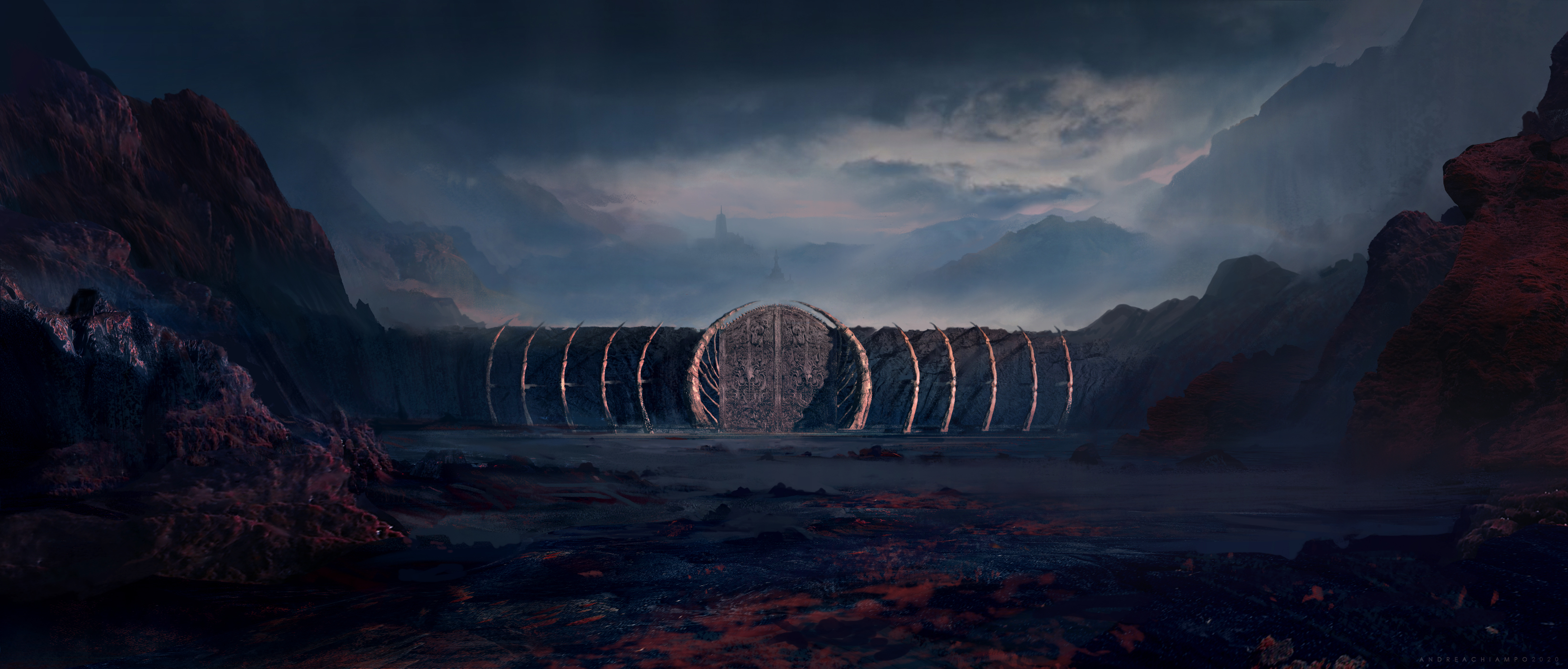
Concept art later expanded that into world-building. Working in entertainment taught me how to create visual languages that feel believable and emotionally immersive. I think my work today exists somewhere between those disciplines: part object, part narrative, part speculative artifact.
OpenSea: You've worked with some of the biggest studios in the world, from Marvel to Disney to Netflix. What does that kind of commercial work teach you, and where does your personal practice fit in alongside it?
Andrea Chiampo: Working with large studios teaches you discipline and clarity. You learn how to communicate ideas efficiently, collaborate with huge teams, and create imagery that immediately conveys emotion or atmosphere.
It also teaches you how powerful visual storytelling can be when many different crafts come together toward a single vision. What I found was that concept art functions like a very meritocratic training ground. You have to stay current with new software, new styles, new technologies, and you have to answer a specific brief even when you're bringing far more to the table than was asked for.
At the same time, my personal practice became a space where I could slow things down and ask more open-ended questions. In commercial work, images usually serve a story that already exists. In my own work, the artwork itself becomes the question.
After probably hundreds of projects across twelve years, I became almost numb to external references. I went back to something like my childhood state, knowing nothing and not wanting to know. When I create my own work now, I don't have a second monitor running references. It's just me and whatever has stayed in my brain as a concept.
I still carry the cinematic language and technical precision from concept art into my practice, but now it's directed toward themes like time, memory, technology, and human systems.
OpenSea: FUTURED PAST began in 2019 and has become a defining body of work for you. What was the original idea behind it, and how has it evolved since you first started?
Andrea Chiampo: The true story of how it started is that ZBrush, the software I use for digital sculpting, reached out to include me in a beta test for new filter features. I was delivering tests of various styles: cartoon looks, anime aesthetics, things the industry was asking for. But then something clicked and I started developing what you see in FUTURED PAST: a style evoking ancient prints and lithographies. They didn't respond to it. They weren't engaged. They never even asked me to deliver that filter.
In hindsight, that rejection was a blessing. If they had loved it, that style would now be a preset available to anyone in the software. Instead I kept it, and it became my personal project. While I kept working on major film and game productions, my free time was entirely devoted to FUTURED PAST.
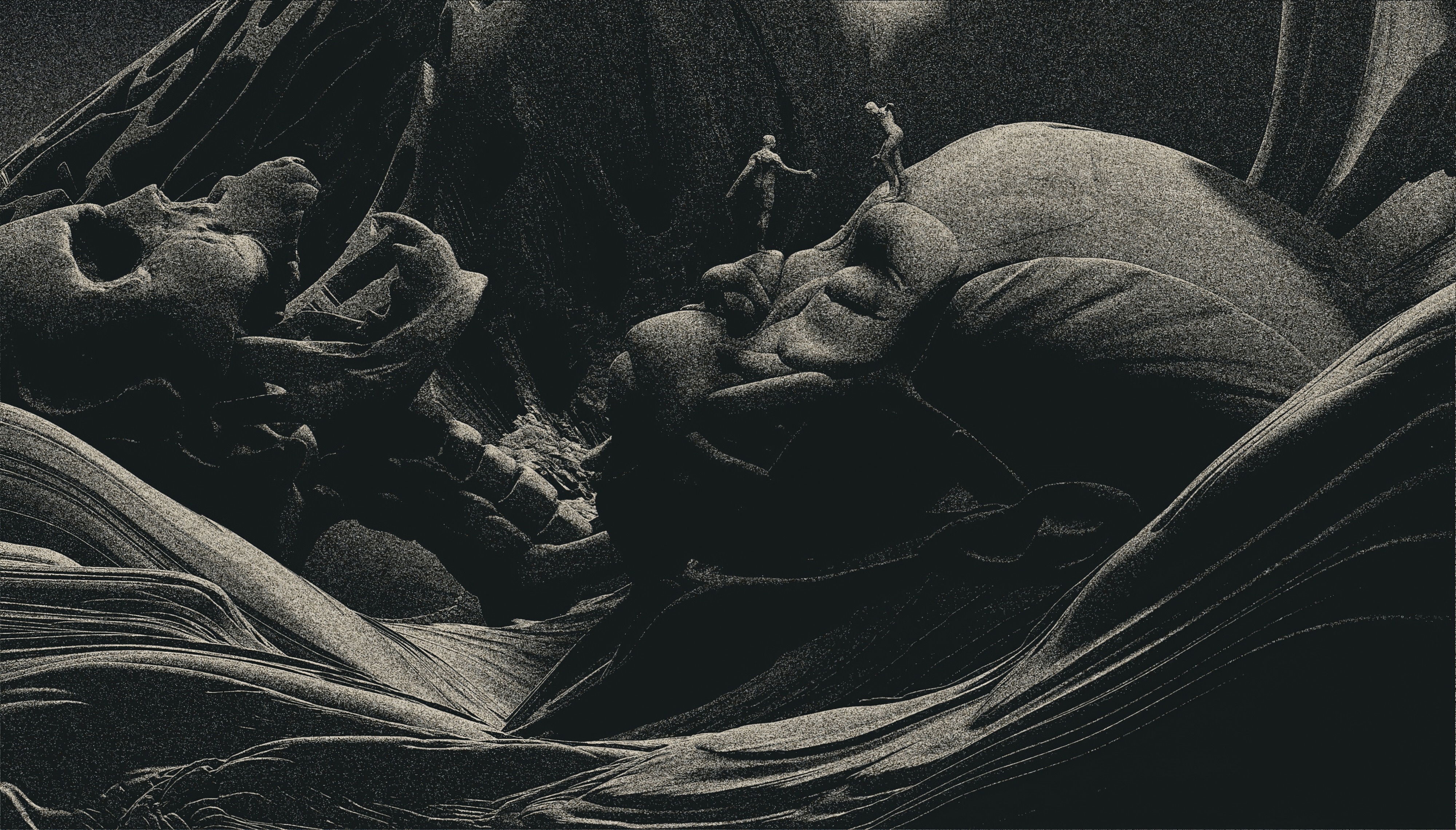
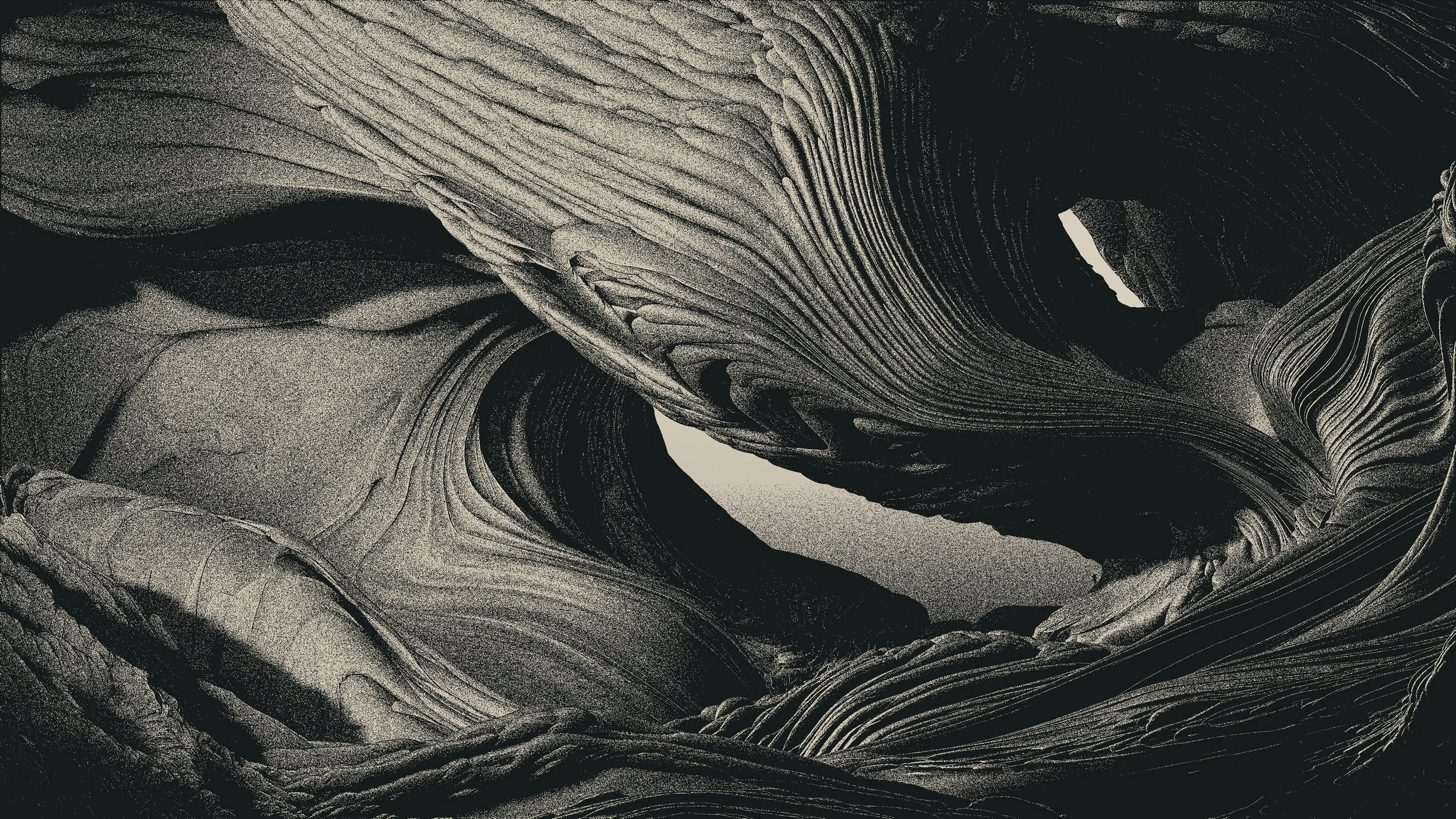
FUTURED PAST started from a very simple fascination: the contradiction between ancient craftsmanship and emerging technologies. At the time, I was creating highly detailed digital sculptures in ZBrush, but I became increasingly interested in making them feel timeless rather than futuristic in a conventional sense. I wanted people to look at the work and feel uncertain about when it was made.
Over time, the project evolved beyond aesthetics and became more conceptual. It expanded into physical printmaking, sculpture, blockchain systems, cryptography, and performative processes. The central idea remained the same though: exploring how humanity leaves traces across time, and how technology itself may eventually become archaeology.
.jpg)
OpenSea: Your pieces are designed to evoke antique lithographies, blurring the line between something that feels centuries old and something made with cutting-edge 3D technology. What draws you to that tension, and how intentional is the sense of illusion in your work?
Andrea Chiampo: The illusion is extremely intentional. I'm interested in creating a moment of temporal confusion where the viewer cannot immediately place the work in time.
I love the idea that a digital sculpture created with advanced rendering technologies can emotionally resemble an artifact discovered in an archive centuries later. That ambiguity creates friction, and I think friction creates curiosity.
There's also something poetic about using the newest tools available to imitate processes associated with the past. It reflects how technology constantly reshapes our perception of authenticity, memory, and permanence.
I think beauty and mystery are deeply linked. When I release artwork, I often share only the image and the title. No description, no explanation. I want every viewer to own their own unique ticket into the work. I want to light a fire of curiosity. Now that I'm working with more complex systems, some explanation becomes necessary, but that impulse stays the same.
-140%20(dragged).jpg)
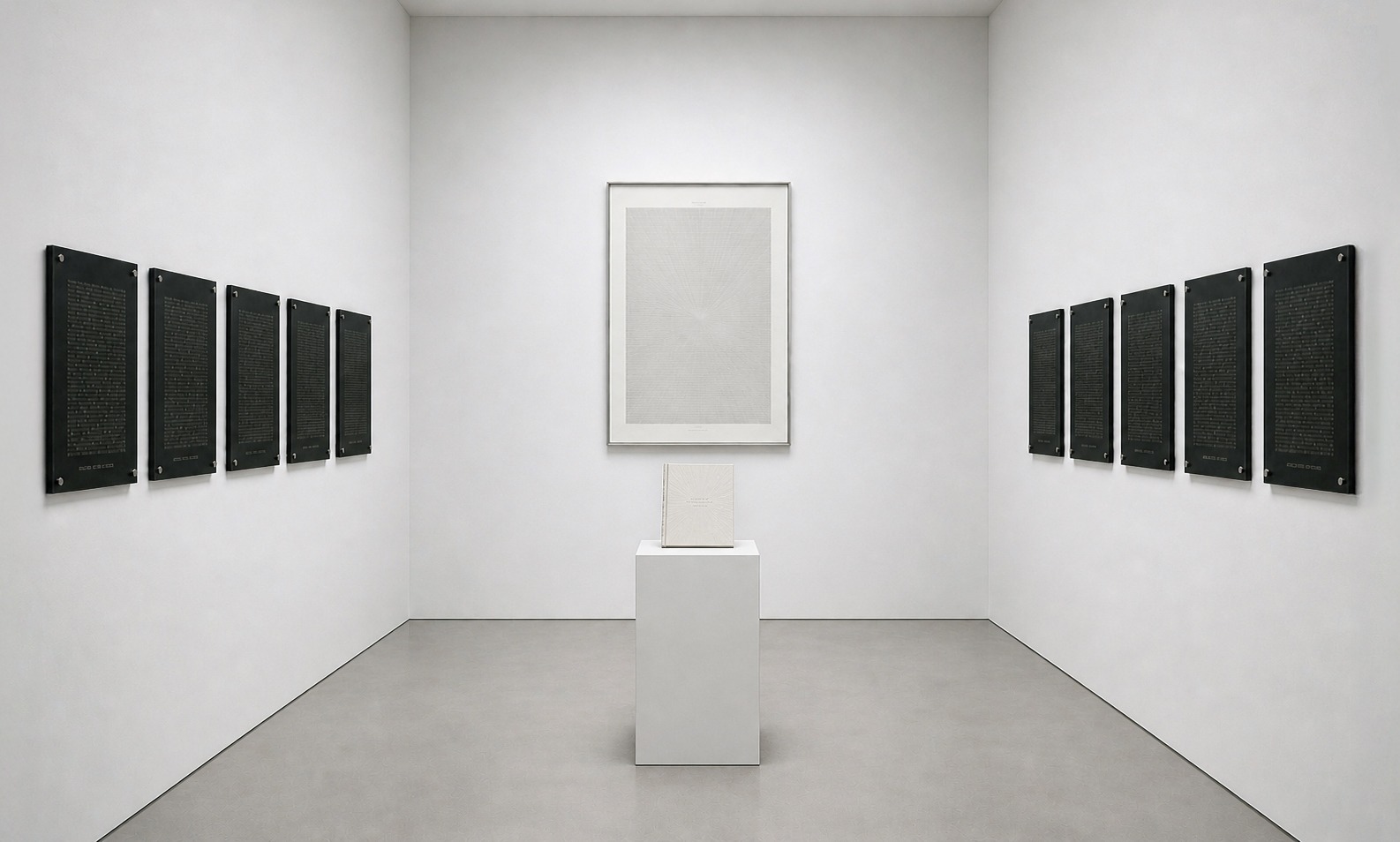
OpenSea: You described MATER NATVRA, your piece at Zero 10 at Art Basel Miami Beach, as a "Proof of Process." The work moved from a live model to digital sculpting to a sterling silver sculpture handcrafted in collaboration with Asprey Studio. Can you walk us through that journey and what it means to you to bring a digital work into physical form?
Andrea Chiampo: MATER NATVRA was really about collapsing boundaries between mediums and timelines.
The piece began with a live model who posed for me over days and weeks, almost like a classical sculptural process. I had no shortcuts. I observed directly and transferred every detail through a digital pen, from zero, the same way an old-school master sculptor would work from life. The NFT itself stores multiple images documenting each stage of that process: the rough skeleton-like base, the gradual build-up of form, the movement toward the final detail. The NFT becomes archival proof that this was sculpted by hand, not generated by AI.
From there, the work was realized as a sterling silver object in collaboration with Asprey Studio, where traditional craftsmanship transformed the digital sculpture into a physical piece by hand.
I called it a "Proof of Process" because the process itself became part of the artwork. Every transformation, physical to digital, digital back to physical, left a trace. That journey is deeply connected to FUTURED PAST. I'm interested in how technologies, both ancient and contemporary, can coexist rather than replace one another.
.gif)
OpenSea: Blockchain plays an interesting role in your work, functioning as both a medium and a performative layer. What does that actually look like in practice, and why does that distinction matter to you?
Andrea Chiampo: For me, blockchain is not just a place to store ownership. It can become part of the conceptual structure of the artwork itself.
Sometimes the blockchain acts as a medium, meaning the artwork could not exist without the underlying technology. Other times it becomes performative, where actions happening on-chain actively influence the meaning, evolution, or experience of the piece.
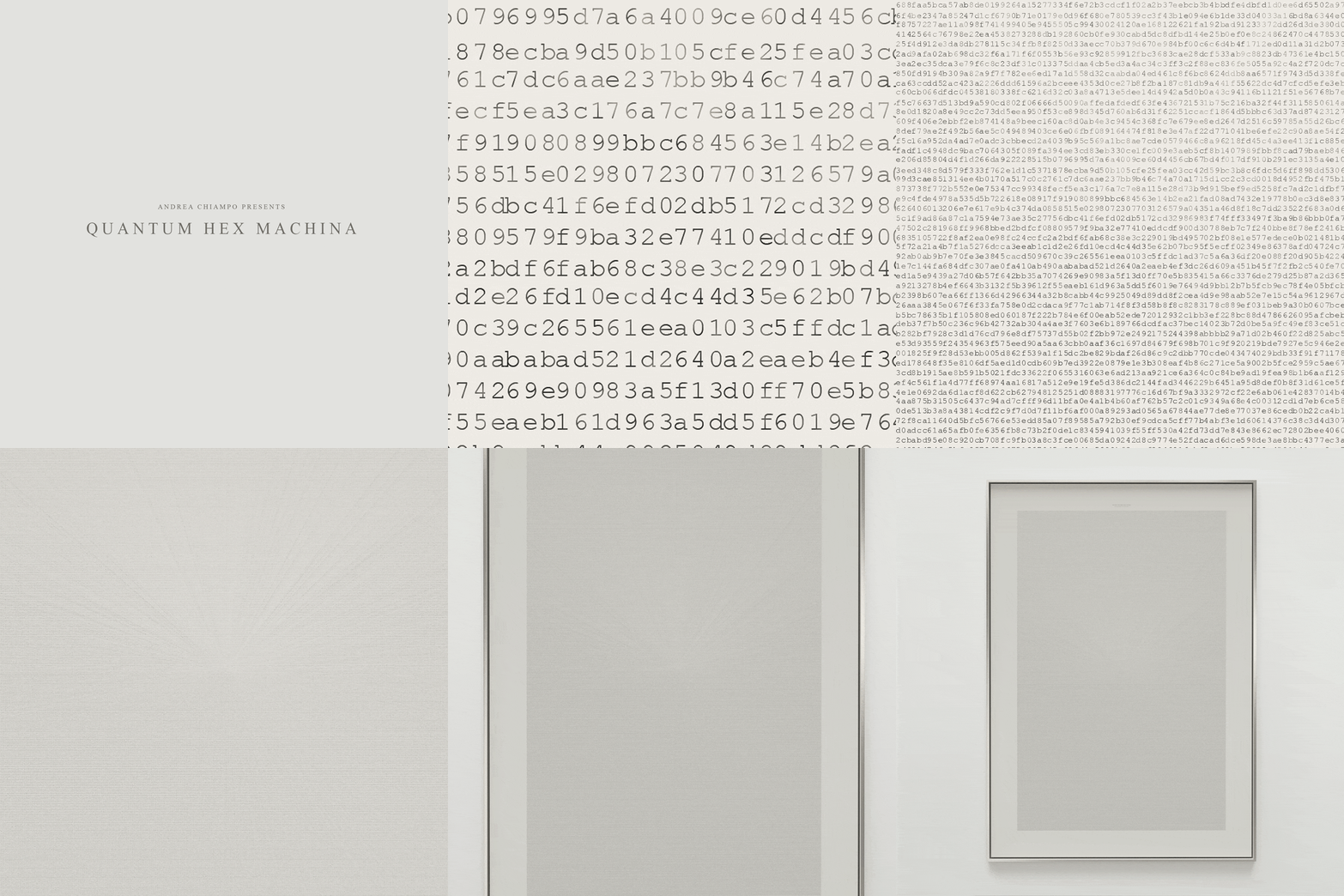
QUANTUM HEX MACHINA is the clearest example. Before creating the project, I deleted a JPEG permanently from every digital storage I owned. Before deleting it, I converted it into a hexadecimal string, then scrambled that string and deleted the original order. The only way to see that image again is to restore the sequence of the string and convert it back, but doing so requires a near-impossible amount of computational power. The number of character combinations runs into the millions. Quantum computing might eventually make it possible, but nothing today can.
In that project, the blockchain serves two purposes simultaneously. It holds the original hash of the image as proof of its existence, and it becomes the permanent, decentralized infrastructure through which whoever solves the puzzle, whether in fifty years or five hundred, can unlock the work. My website won't exist that long. The blockchain will.
That distinction matters because I'm interested in blockchain less as a marketplace and more as a philosophical material. Something that changes ideas around permanence, trust, memory, authorship, and time.
OpenSea: With MATER NATVRA marking a significant chapter in FUTURED PAST, what comes next for you?
Andrea Chiampo: MATER NATVRA closed a specific chapter within the project, but FUTURED PAST continues. What I feel is more like fulfillment: I delivered what I needed to deliver visually. Now it's time to evolve.
Since 2023, I've been working on a major new project that I'll release soon. It still lives entirely within the FUTURED PAST universe, but it pushes further into systems-based work, participation, cryptography, AI, and physical processes that involve the audience more directly.
QUANTUM HEX MACHINA will also have an extension coming. I'm exploring a structure where new works exist as a system inside the original system, where QUANTUM HEX MACHINA must be unlocked before the related pieces can be accessed. The artwork as a set of nested conditions.
I'm increasingly interested in artworks that behave almost like living systems rather than static objects. In many ways, the next chapter is less about creating images and more about creating experiences, structures, and rituals around technology and human presence.
Disclaimer: This content is for informational purposes only and should not be construed as financial or trading advice. References to specific projects, products, services, or tokens do not constitute an endorsement, sponsorship, or recommendation by OpenSea. OpenSea does not guarantee the accuracy or completeness of the information presented, and readers should independently verify any claims made herein before acting on them. Readers are solely responsible for conducting their own due diligence before making any decisions.


.png)
.png)
.png)