ディスカバー
コレクション
トークン
スワップ
ドロップ
アクティビティ
報酬
スタジオ
/
アイテム
所有者
アクティビティ
集約
ネットワーク
サービス利用規約
プライバシーポリシー
$3,354.52
Composition #92

In the wake of other conceptual artists, systems artists and generative artists, like them, Schwittlick chose to refuse Romanticism and its influence, deploying strategies to avoid the human hand and all the mystique and sentimentality that pervasively come along with it. That’s why he uses code, computers, plotters and other paraphernalia. However, paradoxically, one of his most recurrent sources of entropy are his 10 years-long recorded computer mouse movements. In order to create the marks and lines of the lumonigrams, he used this specific corpus, employing a pseudo-random, or, better said, meta-random selection which isn’t done by Schwittlick himself but by his custom software system.
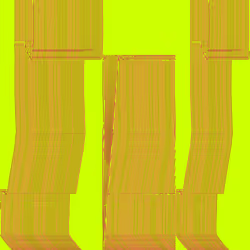
The tool, the mouse, intermediates hand and intention in the abstract realm named technically as “graphical user interface”. Motion is detected by the tool and digitised – input is being put into binary data. Digitising is a process of translating; thus, like in every translation, there is an inevitable loss of quality. This applies to all other processes where digital touch analogue. The digital is the smallest common denominator for all media and thus “flattens” everything.

Tools are extensions of our bodies, as Marshall McLuhan concluded, and the computer mouse is no different. But the mouse line recorded by Schwittlick is a rather ambiguous body trace. If recording alters information, as we have seen, these lines are not any kind of romantic trace, like someone’s signature or a sumi-e painting. They are ambiguous and impure signs that challenge quick categorizations, they are unconscious, not controlled, not artificial and not deliberately designed. He labels these lines “passive drawing”.

The most reliable framework to approach these signs “safely”, then, is through the lenses of the algorithm’s parameters. The data is classified according to a measure of low and high entropy. “Low entropy” is a class of lines which are more predictable, therefore, formally more simple. “High entropy” has more information, thus, it entails less predictable forms. Schwittlick uses only high entropy ones in this series.

The database of recorded mouse movements constitute an extensive digital library of at-first-glance random scribbles. Are these drawings really random? What is randomness? John Cage said: “the first question I ask myself when something doesn't seem to be beautiful is ‘why do I think it is not beautiful?’ and very shortly you discover there's no reason. If we can conquer that dislike or begin to like what we did dislike, then the world is more open.” Can one say the drawings derived from mouse movements are random? They might appear soulless, perhaps, but are they, really?

Schwittlick conceives these recorded movements as samples from nature, and with his context engineering thinking, refuses to create from scratch in the manner of the genius myth. Whatever comes from nature, what I call the incessant flux of events, is arguably soulful, devine, following John Cage’s steps. The inconspicuous is the degree zero of aesthetics and Schwittlick’s works are suitable media to make this evident.

Composition #92 (Digital)

Ethereum
250
2023年11月
アート
Ethereum
250
2023年11月発売
アート
最低価格
0.0519 ETH
1階 %0%
トップオファー
—
24時間の出来高 0.00 ETH
合計出来高0.10 ETH
出品中0.4%
所有者 (一意)68 (27.2%)

Composition #92 (Digital)

Ethereum
250
2023年11月
アート
Ethereum
250
2023年11月発売
アート
探索
アイテム
オファー
所有者
特性
アクティビティ
当社について

Composition #92 (Digital)

Ethereum
250
2023年11月
アート
Ethereum
250
2023年11月発売
アート
最低価格
0.0519 ETH
1階 %0%
トップオファー
—
24時間の出来高 0.00 ETH
合計出来高0.10 ETH
出品中0.4%
所有者 (一意)68 (27.2%)

Composition #92 (Digital)

Ethereum
250
2023年11月
アート
Ethereum
250
2023年11月発売
アート
探索
アイテム
オファー
所有者
特性
アクティビティ
当社について
Composition #92

In the wake of other conceptual artists, systems artists and generative artists, like them, Schwittlick chose to refuse Romanticism and its influence, deploying strategies to avoid the human hand and all the mystique and sentimentality that pervasively come along with it. That’s why he uses code, computers, plotters and other paraphernalia. However, paradoxically, one of his most recurrent sources of entropy are his 10 years-long recorded computer mouse movements. In order to create the marks and lines of the lumonigrams, he used this specific corpus, employing a pseudo-random, or, better said, meta-random selection which isn’t done by Schwittlick himself but by his custom software system.

The tool, the mouse, intermediates hand and intention in the abstract realm named technically as “graphical user interface”. Motion is detected by the tool and digitised – input is being put into binary data. Digitising is a process of translating; thus, like in every translation, there is an inevitable loss of quality. This applies to all other processes where digital touch analogue. The digital is the smallest common denominator for all media and thus “flattens” everything.

Tools are extensions of our bodies, as Marshall McLuhan concluded, and the computer mouse is no different. But the mouse line recorded by Schwittlick is a rather ambiguous body trace. If recording alters information, as we have seen, these lines are not any kind of romantic trace, like someone’s signature or a sumi-e painting. They are ambiguous and impure signs that challenge quick categorizations, they are unconscious, not controlled, not artificial and not deliberately designed. He labels these lines “passive drawing”.

The most reliable framework to approach these signs “safely”, then, is through the lenses of the algorithm’s parameters. The data is classified according to a measure of low and high entropy. “Low entropy” is a class of lines which are more predictable, therefore, formally more simple. “High entropy” has more information, thus, it entails less predictable forms. Schwittlick uses only high entropy ones in this series.

The database of recorded mouse movements constitute an extensive digital library of at-first-glance random scribbles. Are these drawings really random? What is randomness? John Cage said: “the first question I ask myself when something doesn't seem to be beautiful is ‘why do I think it is not beautiful?’ and very shortly you discover there's no reason. If we can conquer that dislike or begin to like what we did dislike, then the world is more open.” Can one say the drawings derived from mouse movements are random? They might appear soulless, perhaps, but are they, really?

Schwittlick conceives these recorded movements as samples from nature, and with his context engineering thinking, refuses to create from scratch in the manner of the genius myth. Whatever comes from nature, what I call the incessant flux of events, is arguably soulful, devine, following John Cage’s steps. The inconspicuous is the degree zero of aesthetics and Schwittlick’s works are suitable media to make this evident.

Composition #92

In the wake of other conceptual artists, systems artists and generative artists, like them, Schwittlick chose to refuse Romanticism and its influence, deploying strategies to avoid the human hand and all the mystique and sentimentality that pervasively come along with it. That’s why he uses code, computers, plotters and other paraphernalia. However, paradoxically, one of his most recurrent sources of entropy are his 10 years-long recorded computer mouse movements. In order to create the marks and lines of the lumonigrams, he used this specific corpus, employing a pseudo-random, or, better said, meta-random selection which isn’t done by Schwittlick himself but by his custom software system.

The tool, the mouse, intermediates hand and intention in the abstract realm named technically as “graphical user interface”. Motion is detected by the tool and digitised – input is being put into binary data. Digitising is a process of translating; thus, like in every translation, there is an inevitable loss of quality. This applies to all other processes where digital touch analogue. The digital is the smallest common denominator for all media and thus “flattens” everything.

Tools are extensions of our bodies, as Marshall McLuhan concluded, and the computer mouse is no different. But the mouse line recorded by Schwittlick is a rather ambiguous body trace. If recording alters information, as we have seen, these lines are not any kind of romantic trace, like someone’s signature or a sumi-e painting. They are ambiguous and impure signs that challenge quick categorizations, they are unconscious, not controlled, not artificial and not deliberately designed. He labels these lines “passive drawing”.

The most reliable framework to approach these signs “safely”, then, is through the lenses of the algorithm’s parameters. The data is classified according to a measure of low and high entropy. “Low entropy” is a class of lines which are more predictable, therefore, formally more simple. “High entropy” has more information, thus, it entails less predictable forms. Schwittlick uses only high entropy ones in this series.

The database of recorded mouse movements constitute an extensive digital library of at-first-glance random scribbles. Are these drawings really random? What is randomness? John Cage said: “the first question I ask myself when something doesn't seem to be beautiful is ‘why do I think it is not beautiful?’ and very shortly you discover there's no reason. If we can conquer that dislike or begin to like what we did dislike, then the world is more open.” Can one say the drawings derived from mouse movements are random? They might appear soulless, perhaps, but are they, really?

Schwittlick conceives these recorded movements as samples from nature, and with his context engineering thinking, refuses to create from scratch in the manner of the genius myth. Whatever comes from nature, what I call the incessant flux of events, is arguably soulful, devine, following John Cage’s steps. The inconspicuous is the degree zero of aesthetics and Schwittlick’s works are suitable media to make this evident.